
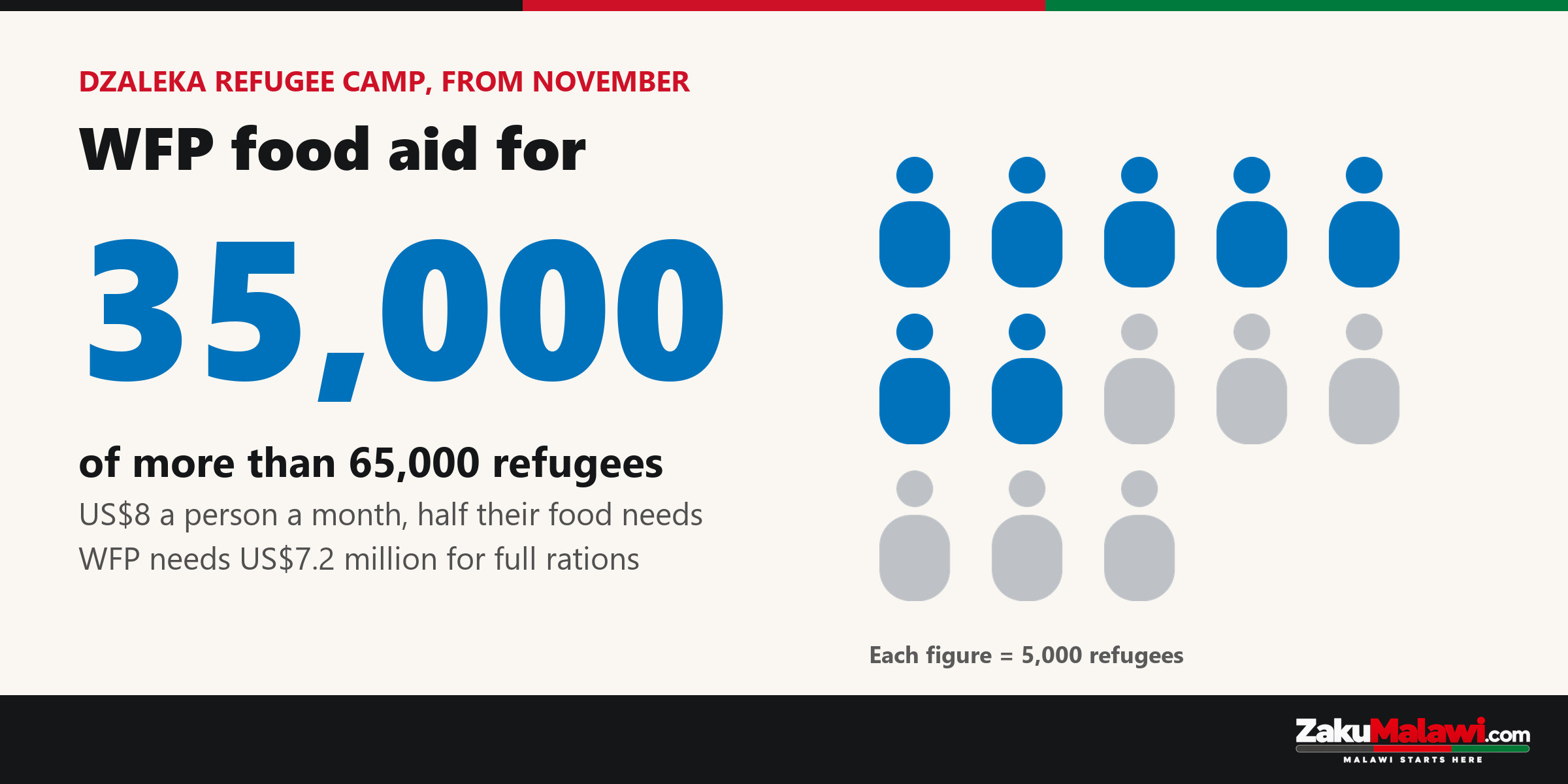
The World Food Programme will from November give food assistance to only the 35,000 most vulnerable refugees at Dzaleka camp, out of more than 65,000, because of funding shortfalls. The rest will no longer get WFP food help.
WFP announced the change in a statement on Friday 13 November. It says it urgently needs US$7.2 million, about K12.4 billion, to give refugees full rations through April 2027.
Key facts
- 35,000 of the more than 65,000 refugees at Dzaleka keep food assistance
- US$8 a person a month in cash, about K13,875, covering half their food needs
- WFP needs US$7.2 million, about K12.4 billion, for full rations to April 2027
- The change starts in November
What changed
Since 2022, WFP has covered up to 75 percent of refugees’ food needs. It says that level can no longer be sustained as funding falls and the number of refugees grows. The 35,000 were chosen through a vulnerability assessment, using categories agreed by WFP, UNHCR, the government and refugee representatives. Refugees who are not chosen keep their refugee status and rights, the statement says.
What it means for a family
The US$8 is per person each month, so a family of five that qualifies gets US$40, about K69,000. Even then it covers only half of what they need to eat. Families who do not qualify get nothing from WFP, including some with little or no way of earning a living, WFP said.
What the agencies said
“We are no longer just cutting rations, we are being forced to cut people off food assistance altogether,” said Hyoung-Joon Lim, WFP Representative and Country Director in Malawi. “No one should have to decide which hungry family eats and which goes without.”
Helen Mebrahtu, UNHCR’s acting representative for Malawi, Zambia and Zimbabwe, said refugees’ needs have not fallen but the money to meet them has. General Ignacio Maulana (retired), Commissioner for Refugees at the Ministry of Homeland Security, said Malawi remains committed to protecting people who have fled conflict and persecution.
In February, UNHCR cut its budget for refugee work in Malawi by 90 percent, from US$8 million to US$1 million, after United States aid cuts, The Nation reported.