
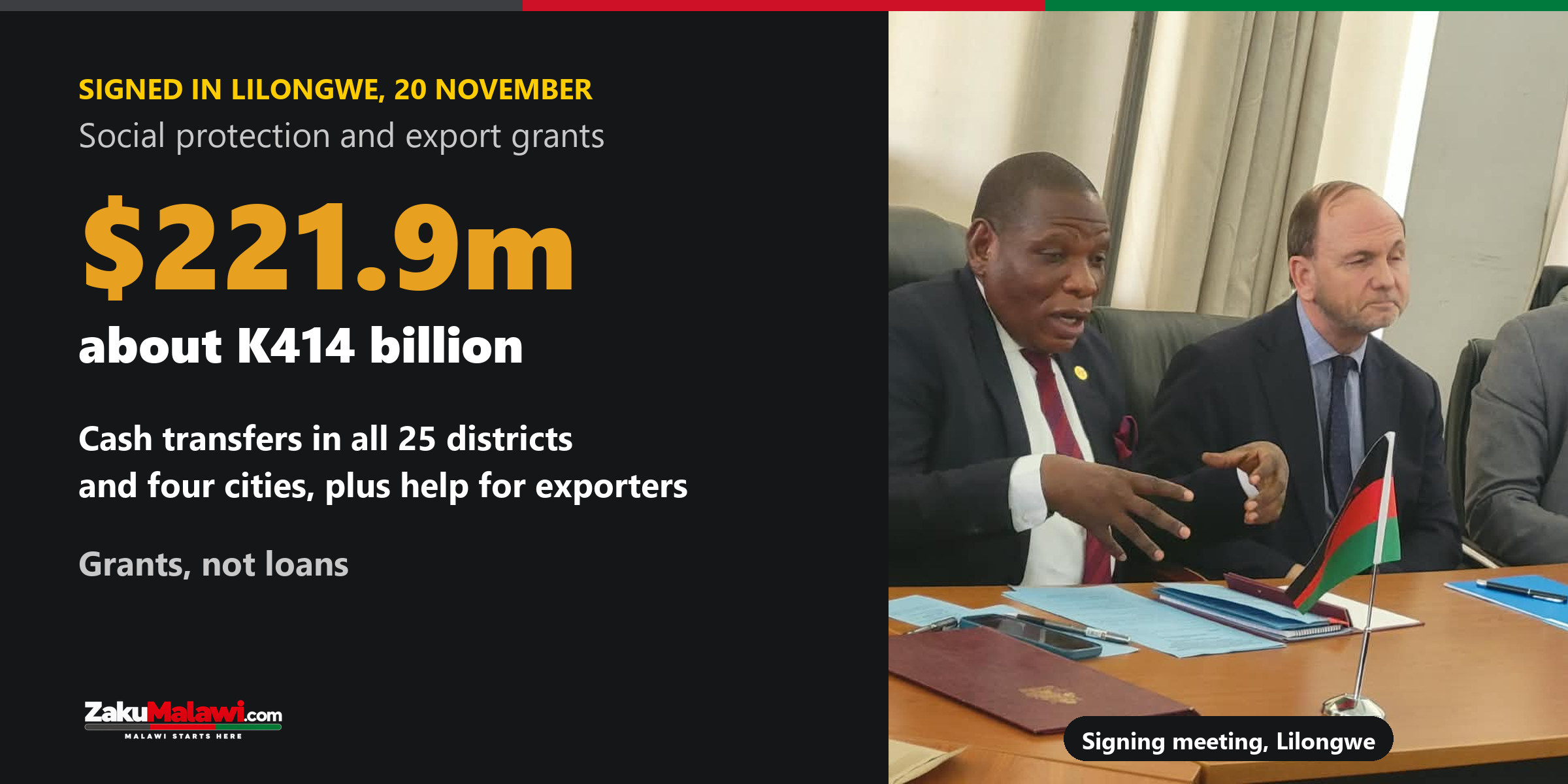
Malawi has signed agreements worth US$221.9 million, about K414 billion, for social protection and exports. Finance Minister Joseph Mwanamvekha signed them in Lilongwe on Friday 20 November with the World Bank and other development partners, Nyasa Times and The Truth reported.
The money is grant money, not a loan, so it does not add to what Malawi owes.
Key facts
- US$221.9 million (about K414 billion) in grants, signed on 20 November
- Most of it, US$165.9 million, is for cash transfers and public works in every district
- The rest backs exporters and small firms
- Donors pay about 95% of the Social Cash Transfer Programme; the government pays about 5%
Where the money goes
INSPIRE-O: social protection
US$165.9 million
Bigger Social Cash Transfer Programme, climate-smart public works that pay people to rebuild their communities, and extra drought money for the 10 most drought-prone districts. All 25 districts and four cities.
M-THRiVE and linked grants: exports
The other US$56 million
Help for exporters, their suppliers and youth- and women-led firms: export readiness, bank finance and reforms to cut the cost of doing business.
The social protection project is paid for by the World Bank’s International Development Association (US$110 million), a multi-donor trust fund backed by the EU, Ireland, Norway, Iceland, the UK and Germany (US$46.7 million) and the Global Shield Financing Facility (US$9.2 million), according to the World Bank. It will also upgrade the Malawi Social Registry and the systems that decide who gets paid, so support reaches the right people faster.
What they said
“For a country where too many families live one failed harvest away from hunger, this financing is hope,” Mwanamvekha said. He told The Truth that some of the money would start flowing soon and could ease pressure on Malawi’s foreign exchange reserves.
Firas Raad, the World Bank’s division director for Malawi, said the country still faces foreign exchange shortages, fiscal pressures, debt problems and a narrow export base. “The real test of reform is whether stabilization translates into investment, exports, jobs and greater economic security for Malawian families,” he said.
Who calls the shots
Malawi’s main cash transfer scheme is almost entirely paid for from outside. A study in the Malawi Journal of Politics and Public Affairs, reported by The Nation in September, found donors provide about 95% of its funding.
Who pays for the Social Cash Transfer Programme
World Bank36%
Germany27%
European Union23%
Irish Aid7%
Malawi Government5%
Unicef1%
Because of that, the study argued, donors have gained outsized say over how the programme is designed and run: they set the pace, decide how families are picked and influence policy. “The donor dependency is unsustainable and poses an existential threat to millions of Malawians,” Gender Minister Mary Navicha said, adding that global funding cuts had already reduced coverage.
The government says it is starting to pay more. It now funds cash transfers directly in five districts, up from one a year earlier. Its new Social Protection Financing Strategy looks at fuel levies, mining revenue and pension compliance to raise money at home, because most donors may stop their support after 2030.
What to watch
Friday’s money will be judged on whether cash reaches the households on the register, and whether the new systems stop it leaking on the way. For the food side of this season, see how much maize DoDMA has for the El Niño response.