
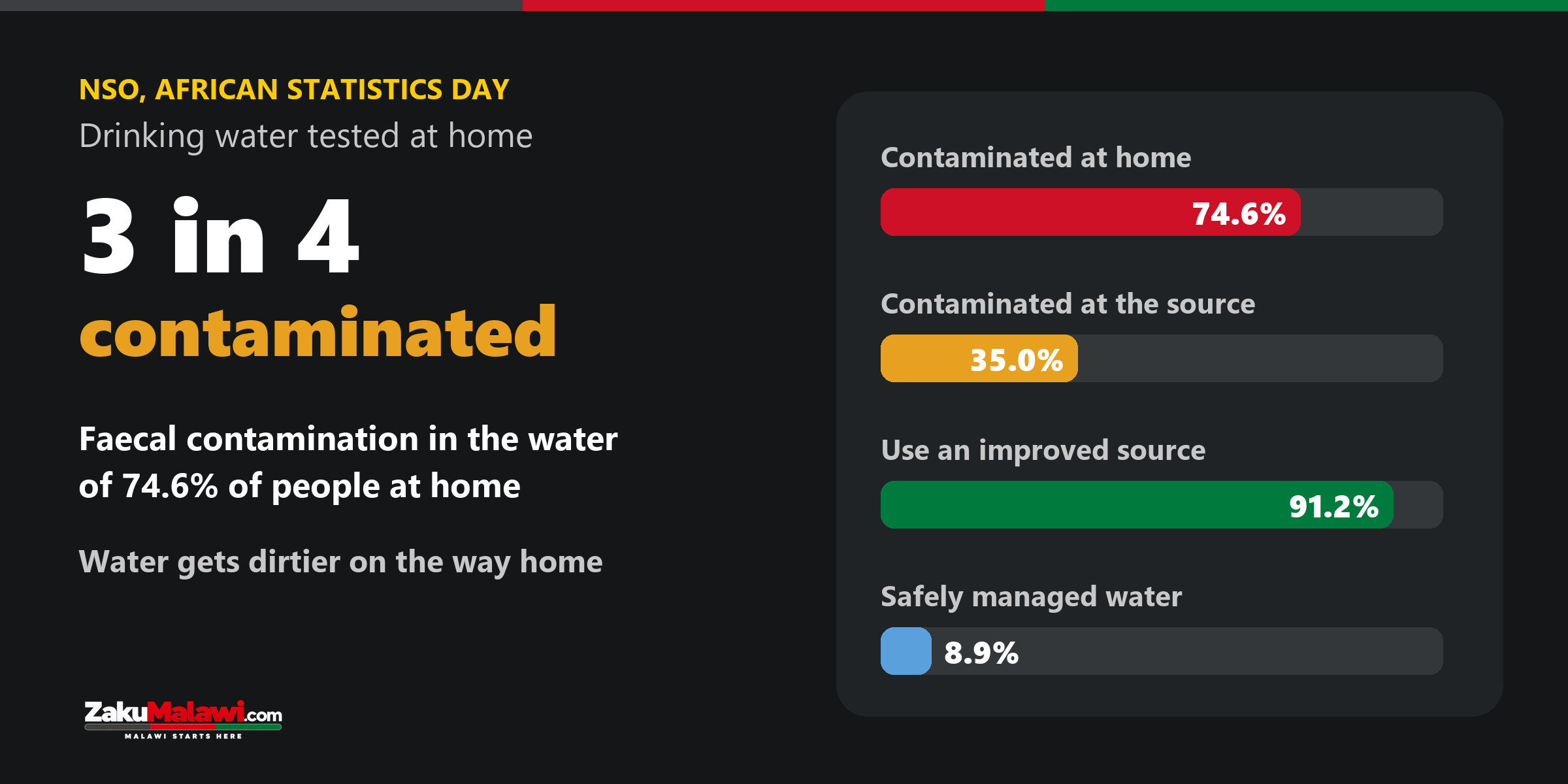
Three in four Malawians drink water that carries signs of human or animal waste by the time it reaches the home, the National Statistical Office says. Faecal contamination was found in the drinking water of 74.6 percent of the population when it was tested in the household, against 35.0 percent when it was tested at the source.
The NSO released the figures for African Statistics Day on 18 November 2026, held this year under the theme of water and sanitation statistics, Malawi Voice reported. They are survey measurements of water at the source and in the home, not a report of a new spill or burst pipe.
Key facts
- 74.6 percent of people had faecal contamination in their drinking water at home, against 35.0 percent at the source
- 91.2 percent use an improved water source, but only 8.9 percent have safely managed drinking water
- Only 54.2 percent have an improved toilet
- Women and girls, mostly in rural areas, do most of the water fetching
WATER IN MALAWI, NSO FIGURES
Contaminated when tested at home
Contaminated when tested at the source
Use an improved water source
Have safely managed drinking water
Share of the population. Contamination means signs of human or animal waste in the water.
Dirtier on the way home
Contamination more than doubles between collection and drinking. The NSO says the way water is carried, handled and stored at home is likely to blame, so a borehole or tap that tests clean does not guarantee safe water in the cup.
That is also why an improved source is not the same as safe water. “Safely managed” means the water is on or near the premises, available when needed and free from contamination, and fewer than 1 in 10 people have that.
Who carries the load
Women and girls in rural areas face the greatest burden, the NSO says, because they do most of the fetching, sometimes walking long distances to the nearest source. Sanitation trails water: just over half of the population has an improved toilet.
What you can do at home
- Store drinking water in a clean container with a lid, and keep it off the floor
- Pour or use a tap rather than dipping cups or hands into the container
- Boil water, or treat it with chlorine from a health centre or shop, before drinking
- Wash the container regularly and wash hands with soap after using the toilet
The NSO also shared the day’s work on its Facebook page, where it linked the theme to planning for the 2028 Population and Housing Census.
Supply problem or dirty tap water? Find your water board and its fault number.