
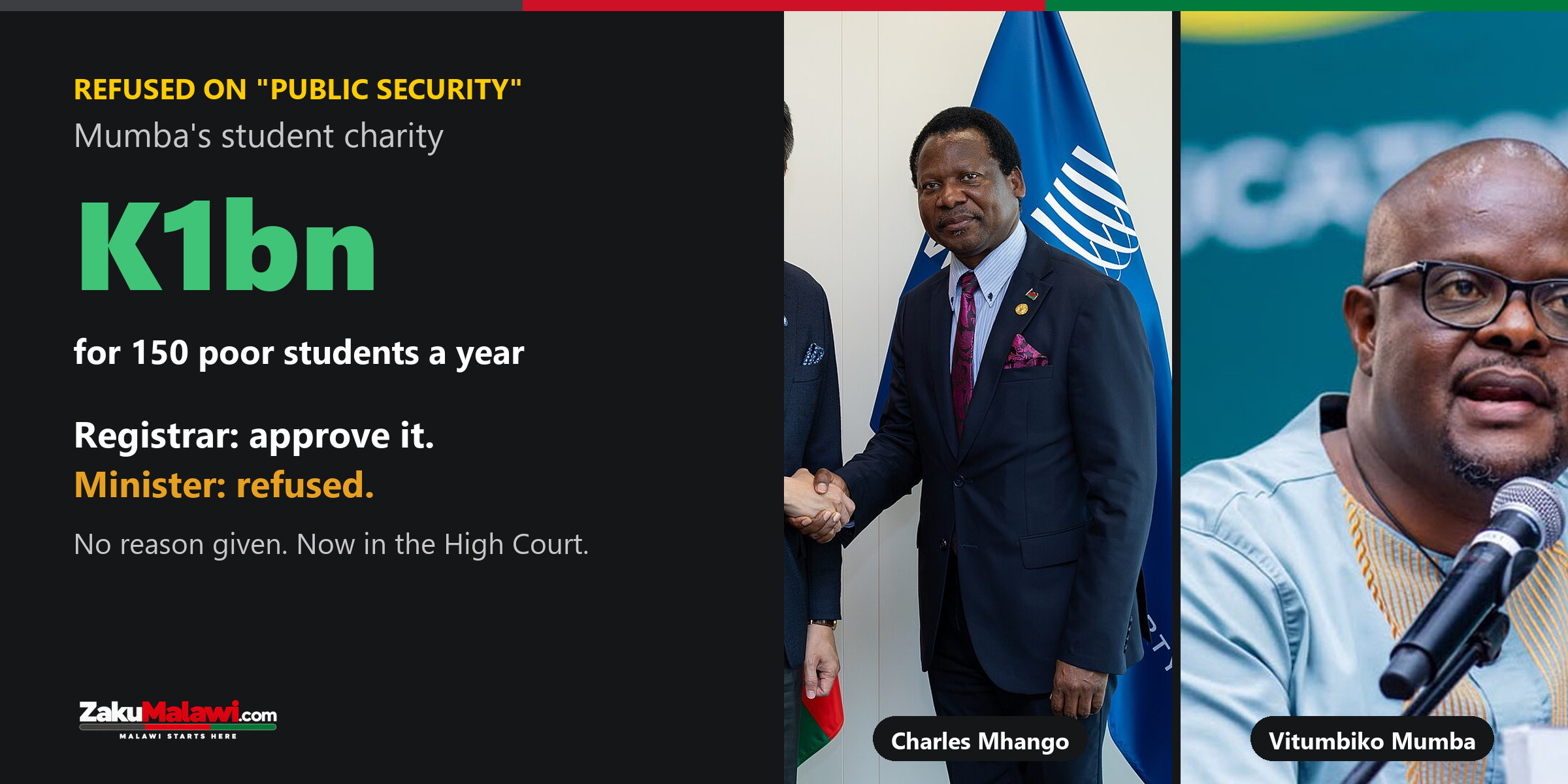
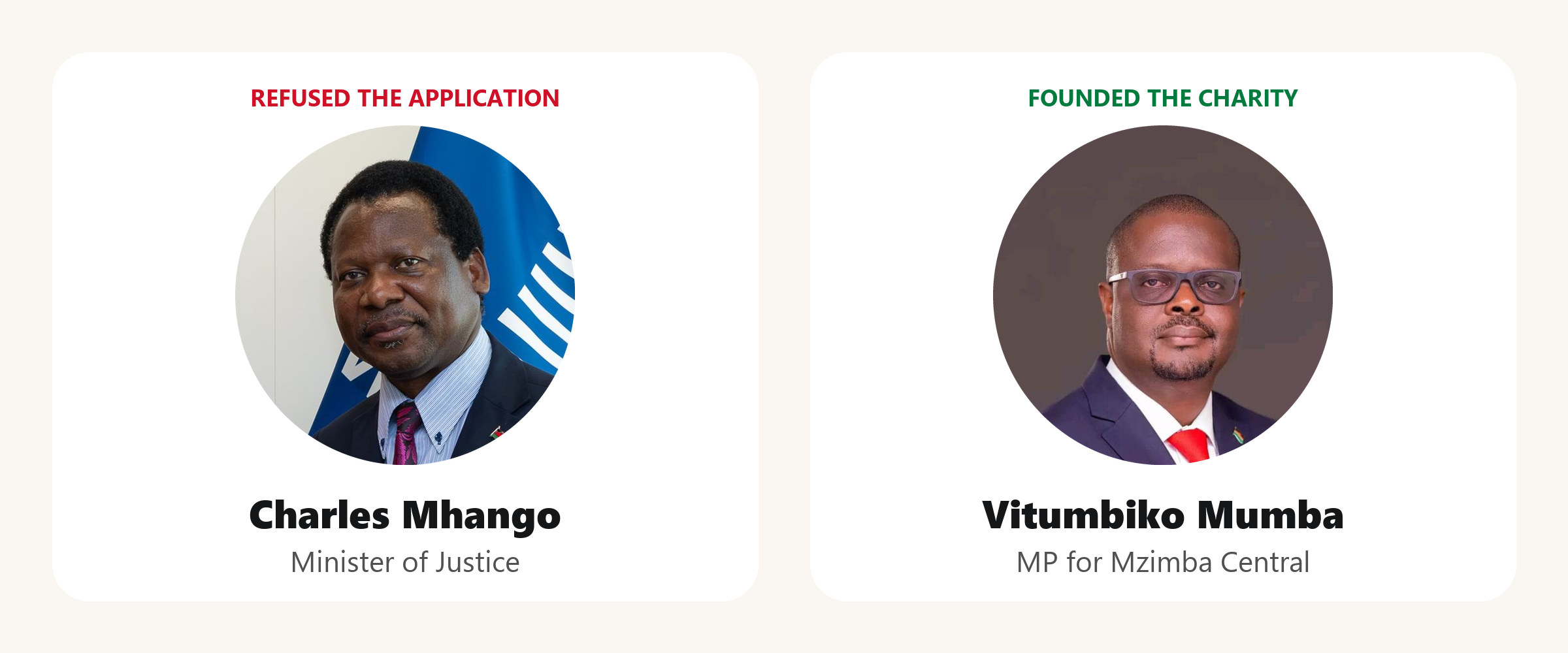
Justice Minister Charles Mhango has refused to register a charity that pays university fees and stipends for poor students, saying registering it would be a risk to public security. The charity, People Over Politics Foundation, was founded by Mzimba Central MP Vitumbiko Mumba.
The foundation has gone to court. On 10 November 2026 it applied to the High Court for a judicial review, arguing that the decision was irrational, unconstitutional and procedurally unfair because it was never shown any evidence of a threat, The Nation reported on 17 November.
Key facts
- The refusal came through the government’s online registration portal on 10 October 2026
- The only reason given: “the grounds of public security”
- Government’s own Registrar General had recommended approval in July
- The foundation’s lawyers asked for the reasons on 12 October and got no reply
- It asked the High Court for a judicial review on 10 November
What happened
“Kindly be advised that the application for incorporation has been refused by the Minister in accordance with the applicable provision of the law on the grounds of public security,” reads the notice, posted on the portal at 2.29pm on 10 October.
It came at the end of a ten-month wait. The foundation first applied on 1 January 2026, and by September its lawyers were threatening legal action over the delay, Nyasa Times reported. Three months before the refusal, Registrar General Chikumbutso Namelo had examined the papers and, in a memo dated 14 July, raised no objection and sent the application to the minister for approval.
HOW IT UNFOLDED
- 1 JanThe foundation applies to register as a charitable trust
- 25 AprIt resubmits after officials ask for corrections
- 14 JulRegistrar General Chikumbutso Namelo raises no objection and recommends approval
- 17 SepIts lawyers give the registry seven days to act or explain the delay
- 2 OctMumba launches the foundation in Lilongwe, still unregistered
- 10 OctThe minister refuses the application “on the grounds of public security”
- 12 OctIts lawyers write to the minister asking what the security concern is. No reply
- 10 NovThe foundation asks the High Court to review the decision
Mhango had not answered The Nation’s questions, sent on Friday with a reminder on Monday, by the time it went to print.
What the foundation does
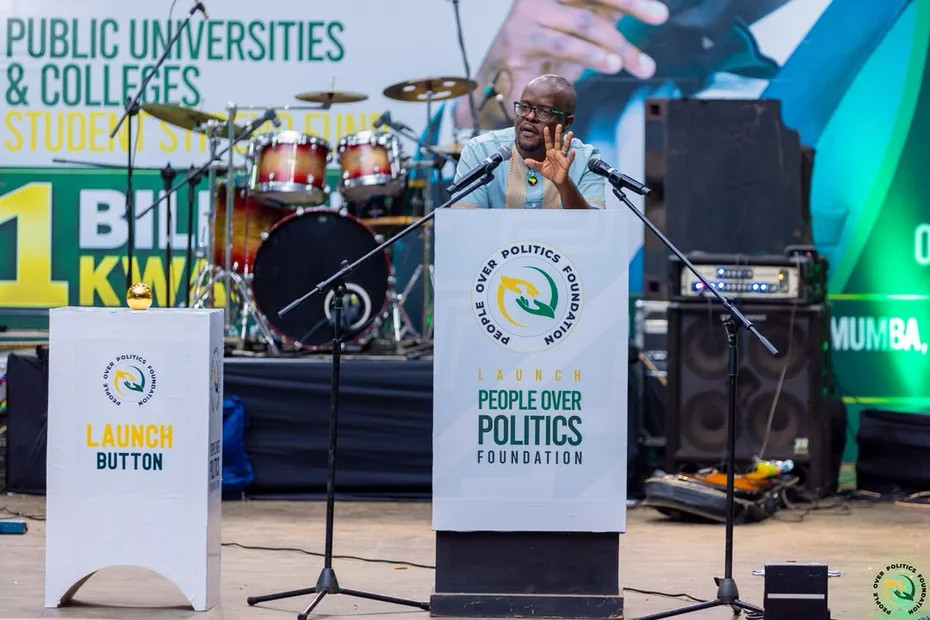
Mumba launched the foundation on 2 October at the Bingu International Convention Centre in Lilongwe. It plans a K1 billion student stipend fund over five years, about K200 million a year for 150 poor students. University students get K1.8 million a year and college students K800,000, The Nation reported. Money had already gone to the University of Malawi, Mzuzu University, Domasi College and LUANAR, it said.
At the launch, Mumba dismissed claims that the foundation is a political party in waiting. “There are many foundations out there that are running. They are not political parties,” he said. The foundation has since advertised jobs in its secretariat.
What the law says
Charities register under the Trustees Incorporation Act. Section 3 says the minister may grant a certificate if he considers it “expedient”, and may refuse “if the Minister is satisfied that it is necessary for the preservation of public security so to do”. That refusal power was added in 1996.
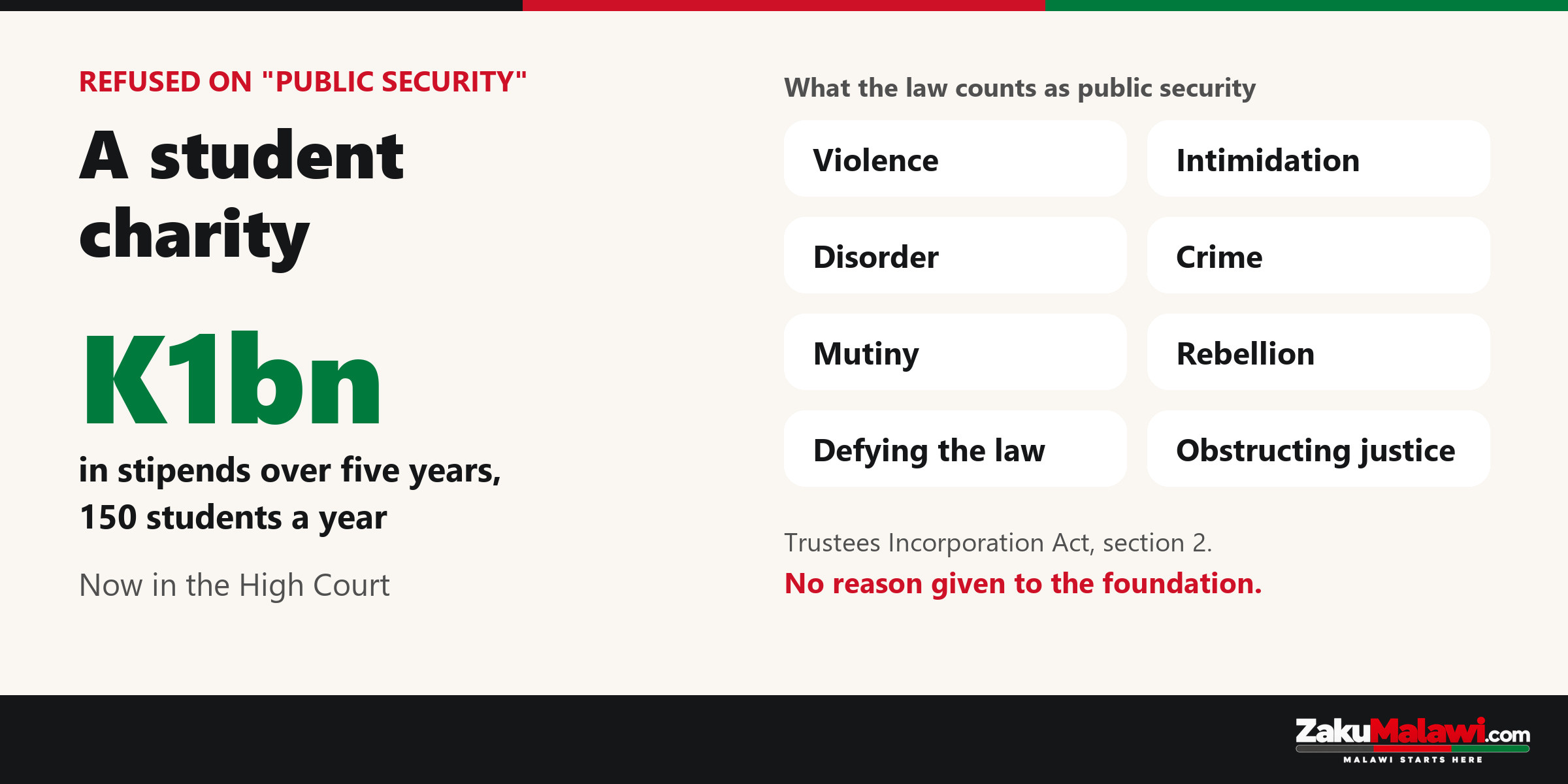
The Act also says what public security means. It “includes the prevention and suppression of violence, intimidation, disorder, crime, mutiny, rebellion and concerted defiance of and disobedience to lawfully constituted authority and laws in force in Malawi, and the maintenance of the administration of justice”.
Does “public security” add up? Our analysis
We set the minister’s reason against the law, the record and what the foundation does. Here is what we found.
Nothing in the record matches the law’s list. The Act names violence, intimidation, disorder, crime, mutiny, rebellion and defiance of the law. The foundation’s published plans are fees and stipends for students, paid through universities. No one, including the minister, has publicly linked it to any of the things on that list.
Government’s own registry saw no problem. The Registrar General’s office is the part of government that checks these applications. It examined this one and recommended approval. If something changed between 14 July and 10 October, the ministry has not said what.
No reasons were given. Section 43 of the Constitution gives everyone the right to be given written reasons for an administrative decision that affects their rights or interests. A month after the foundation’s lawyers asked for them, they still had none. That gap is the heart of the court case.
The refusal does not stop the “threat”. A certificate only makes the trustees a legal body that can sign contracts, own property and sue in its own name. The foundation launched without one and has already paid universities. If it were a danger to the public, refusing the paperwork would do nothing to remove it. What the refusal does do is make the charity harder to run and to fund: Mumba has said the delays already cost it sponsorship pledges.
The politics is hard to ignore. Mumba was the Malawi Congress Party’s running mate in the September 2025 election and now sits as an independent. Some observers see the foundation as the start of a new political base, Nyasa Times reported, though he denies it. “People Over Politics” was also his campaign slogan. In December 2025 police arrested him over remarks after the election and charged him with publishing false information likely to cause public alarm. He pleaded not guilty and was granted bail, Nyasa Times reported; no court has ruled in that case. Mhango, a former Attorney General, was questioned by the Malawi Law Society in 2018 for also acting as legal adviser to the Democratic Progressive Party, now in government.
It has happened before. In 2013 a justice minister refused to register the Association for Secular Humanism, citing religious objections. It was registered only after a new minister took office, according to the ICNL Civic Freedom Monitor.
None of this proves the decision was political. But the law gives the minister this power only for real threats of violence, crime or disorder, and he has not named one. If government has evidence, the simplest answer is to show it to the court. If it does not, many Malawians will read “public security” as politics by another name.

What happens next
The High Court will decide whether the minister acted lawfully. In a judicial review the court can quash a decision and send it back to be made again, properly. Until then, the foundation runs without legal status, and its students wait to see whether the support continues. The foundation has not said whether the refusal will affect payments.

Read the profiles of Charles Mhango and Vitumbiko Mumba, and the foundation’s own site, peopleoverpolitics.co.mw.