
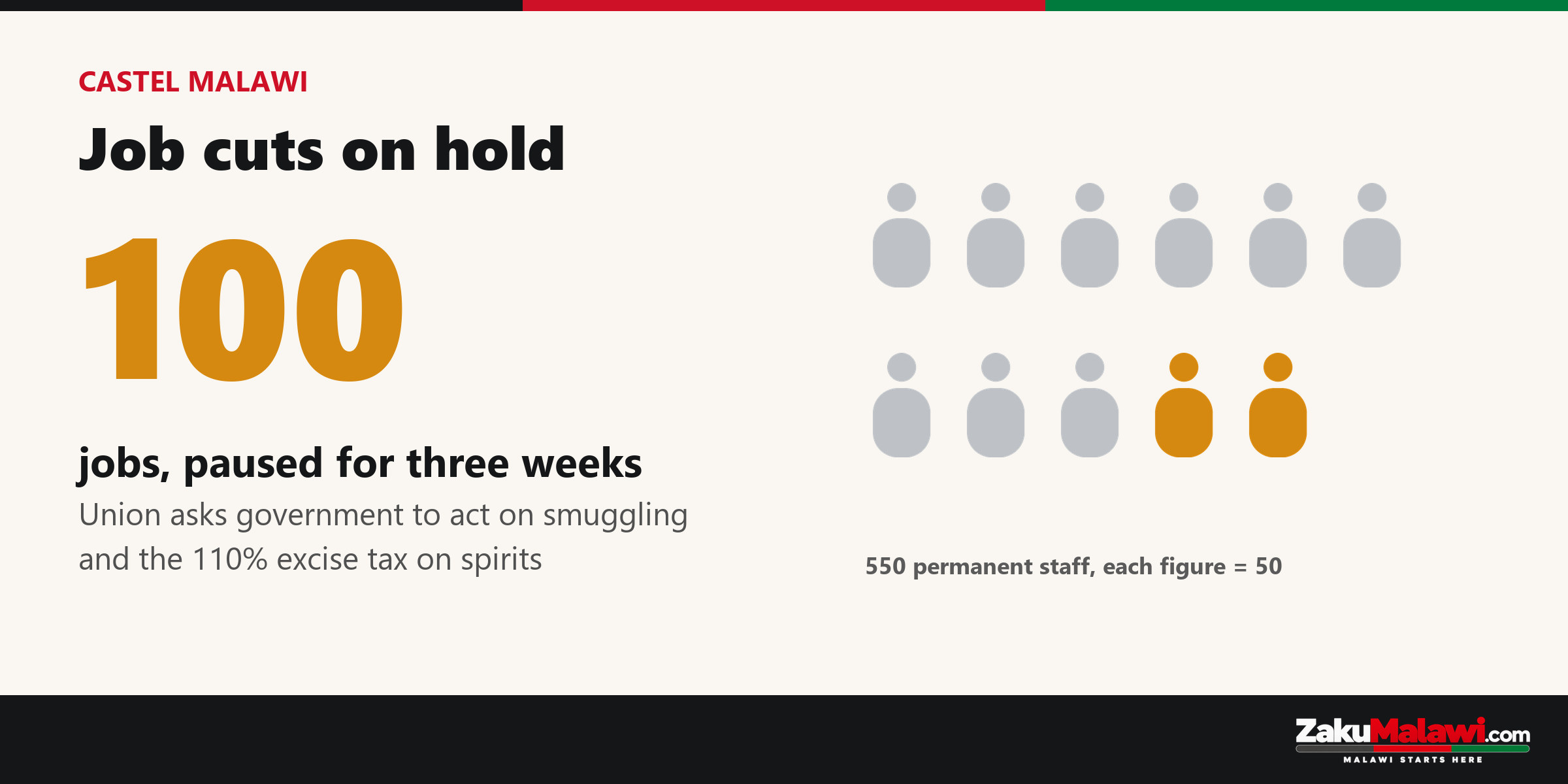
Castel Malawi has put off a plan to cut 100 jobs for three weeks after its workers’ union asked for time to persuade government to act on smuggling and tax. The retrenchment at the brewer, one of the country’s major taxpayers, had been due in the second week of November.
Managing director Thomas Reynaud confirmed the pause. “I can confirm that the workers union engaged us and pleaded that they need time to convince the authorities to rectify the problems for us not to go ahead with our decision of letting go the 100 jobs,” he told The Nation. Castel employs about 550 permanent staff, with thousands more on external contracts.
Key facts
- 100 of about 550 permanent jobs at Castel Malawi are on hold for three weeks
- The cuts had been due in the second week of November
- Castel blames a 110 percent excise tax on spirits, beer smuggling and illicit alcohol
- The union wants talks with Labour, Finance, Trade and the Malawi Revenue Authority
Why Castel wants to cut
Management says the business environment is hurting the company’s operations and its future. It points to the 110 percent excise tax on spirits, beer smuggling and a growing market in illicit alcohol. Malawi’s rate is far above those in neighbouring SADC and COMESA countries, where it is reportedly 60 percent or below, The Nation reported.
What the union wants
Castel Malawi Workers Union (Camawu) president Israel Mughogho said the union is seeking roundtable talks with the Ministry of Labour, Skills and Innovation, the Malawi Revenue Authority, the Ministry of Industrialisation, Business, Trade and Industry, and the Ministry of Finance, Economic Planning and Decentralisation.
“These illicit alcoholic products do not only evade taxes but they also pose a health and safety hazard to the citizens of Malawi,” Mughogho said. He said fixing the policy and market problems could save not only Castel’s 100 jobs but jobs at other drinks makers facing the same pressure, some of which may be quietly cutting staff already.
Why employers are cutting
Employers Consultative Association of Malawi executive director George Khaki said high inflation, even though it has come down in recent months, and a persistent shortage of foreign currency are behind many of the retrenchments now being announced. “Employers are unable to import raw materials, as a result, they are operating below normal capacity,” he said.
The cuts are suspended, not cancelled. Check what the law says about notice and severance pay in our guide to your rights at work in Malawi.