
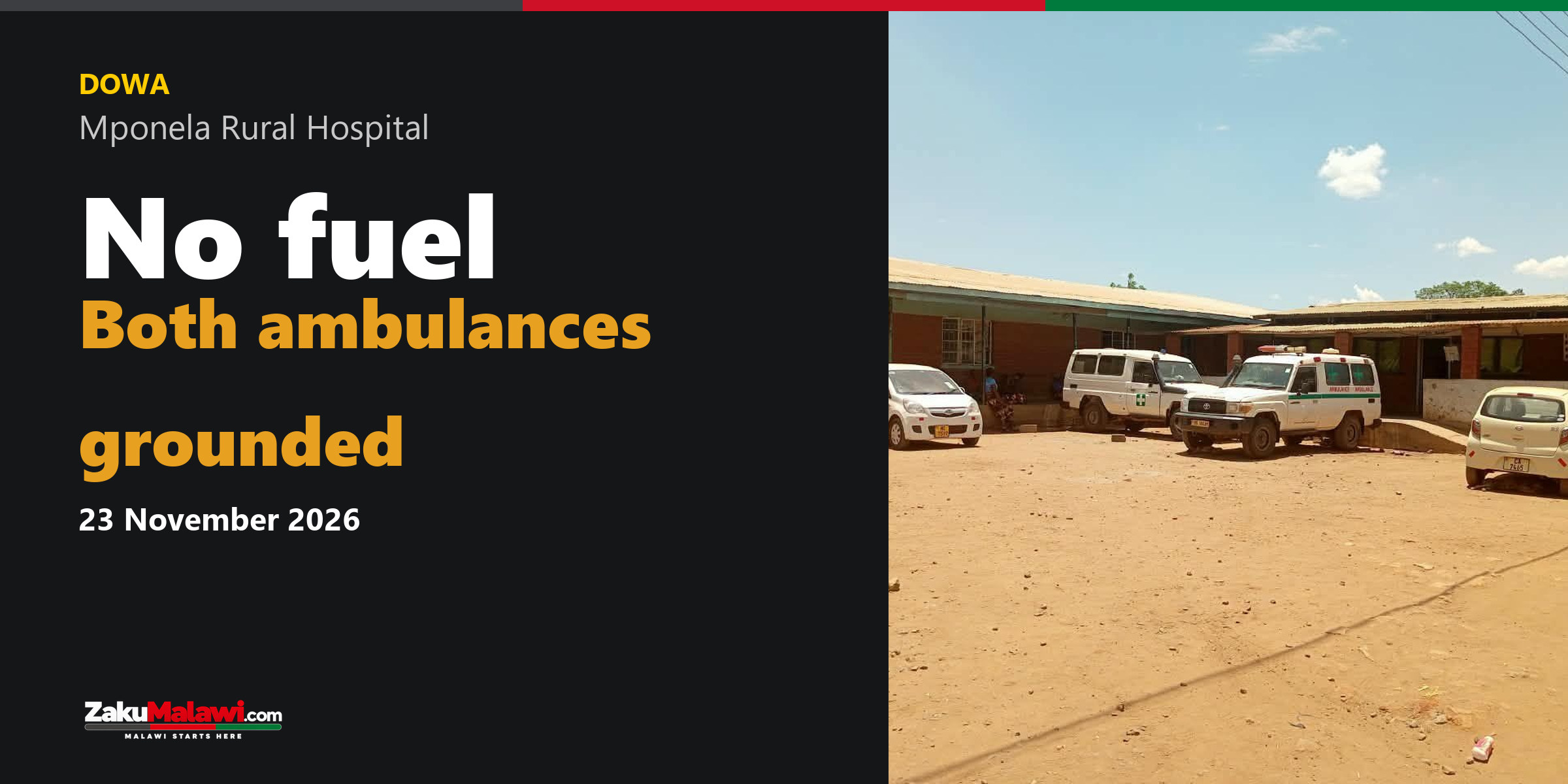
A woman has died at Mponela Rural Hospital in Dowa after staff could not refer her to Dowa District Hospital because the facility had no fuel for its ambulances, hospital in-charge Owen Chipewa told reporters. The mother arrived from Dzoole Health Centre on Monday, 23 November 2026, in critical condition, Malawi24 reported on Tuesday.
Chipewa said she delivered a stillborn baby at Mponela, but her condition kept worsening and staff wanted to move her uphill to Dowa District Hospital. Both of the hospital’s working ambulances were grounded without fuel, so the referral did not happen. Staff tried to stabilise her, but she died. No Ministry of Health press statement on the case was on health.gov.mw when checked on 24 November 2026.
Key facts
- Patient referred from Dzoole Health Centre while in critical condition
- Stillborn delivery at Mponela, then worsening condition
- Planned transfer to Dowa District Hospital did not take place
- Malawi24 links the deaths to wider fuel shortages hitting hospital transport
What the hospital said
Chipewa told Malawi24 the hospital had no fuel to dispatch an ambulance and that the two units that still work were both without fuel, leaving no way to move patients who need a higher-level hospital.
Not the first time at Mponela
- January 2016
A 24-year-old woman died at Mponela after she could not be taken to Dowa District Hospital for lack of ambulance fuel, Nyasa Times reported at the time.
- May 2026
Malawi24 says fuel shortages had already disrupted ambulance services at several hospitals.
- 23 November 2026
Malawi24 reports the latest deaths after another fuel-related referral failure at the same rural hospital.
Broader fuel pressure
Malawi24 said intermittent fuel supplies had persisted for months, with government pointing to foreign exchange pressure and allowing some firms to import fuel for their own use. Rural hospitals that depend on ambulances for referrals can be left exposed when local fuel runs out.
A wider crisis
The deaths at Mponela sit inside a deeper squeeze that Malawians already feel in queues, blackouts and public finances. Malawi24 said the case puts the spotlight on health authorities and government to secure reliable fuel for emergency medical transport, not only for motorists.
| Pressure | What readers see | On Zaku |
|---|---|---|
| Fuel | Months of intermittent supplies and forex strain | MERA fuel prices |
| Power | Rotating ESCOM load shedding | Weekly ESCOM schedule |
| Living costs | 76% in lived poverty, Afrobarometer Aug 2024 fieldwork | Poverty dispatch |
| State firms | Egenco CEO suspended, K2.6bn fee probed | Egenco suspensions |
President Peter Mutharika returned from a private visit to South Africa on 31 October 2026, Malawi24 reported, and spoke to State House media about fuel logistics after landing. With queues, blackouts and hospital breakdowns still mounting three weeks later, many Malawians want a clearer public presence from State House, not only ministers explaining a long recovery.
UTM Party president Dalitso Kabambe urged Mutharika to address the nation, acknowledge how deep the crisis is and set out relief timelines, The Nation reported. Information Minister Shadric Namalomba asked critics to allow at least two years to fix fuel and forex problems he called inherited. Our report on that exchange sets out both sides.
The suffering is real, and the patience of the people is not limitless.
Dalitso KabambeUTM Party president, to The Nation
We continue to hear assurances, but people need concrete action and tangible results, not political rhetoric.
Michael KaiyatsaCentre for Human Rights and Rehabilitation, to The Nation
Egenco is under fresh scrutiny after its board suspended chief executive William Liabunya while Treasury audits a K2.6 billion legal fee and Nyasa Times reports questions over a separate K400 million Kammwamba land memo. Public Accounts Committee scrutiny and frozen accounts show how corruption allegations and weak controls can run alongside day-to-day crises such as empty ambulance tanks.
A health-sector coalition warned in October 2026 that thousands of qualified health workers remain unemployed while hospitals lack staff, The Nation reported, one measure of how little room the system has when fuel runs out at a rural facility.