
Rainy season forecast 2026/27
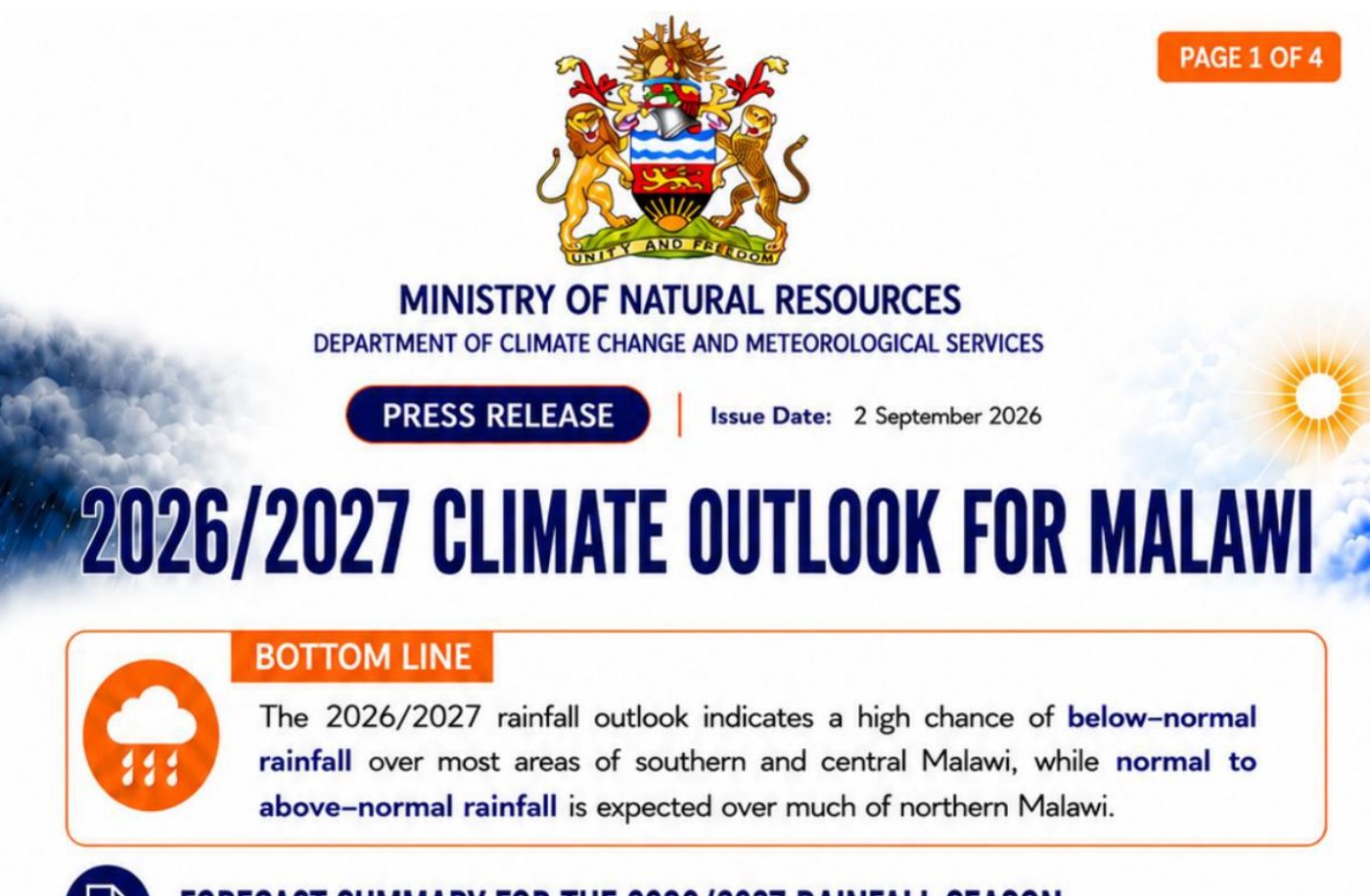
What the Department of Climate Change and Meteorological Services expects this season: how much rain, when it starts and ends, and where dry spells are most likely.
- South: below normal
- North: normal to above
- Rains: from mid-December
Quick answer: The 2026/27 season is expected to be drier than normal in southern and central Malawi and normal to wetter than normal in the north. A strong El Niño is the main reason. The rains are expected to start late in the south, slightly late in the centre and on time in the north, with established rains from mid-December. Long dry spells are likely in January and February, especially in the south, and it will be hotter than usual. This is the official forecast from the Department of Climate Change and Meteorological Services (DCCMS), issued on 2 September 2026.
What do you need?
Tap a card to jump to it.
Rainfall forecast by region
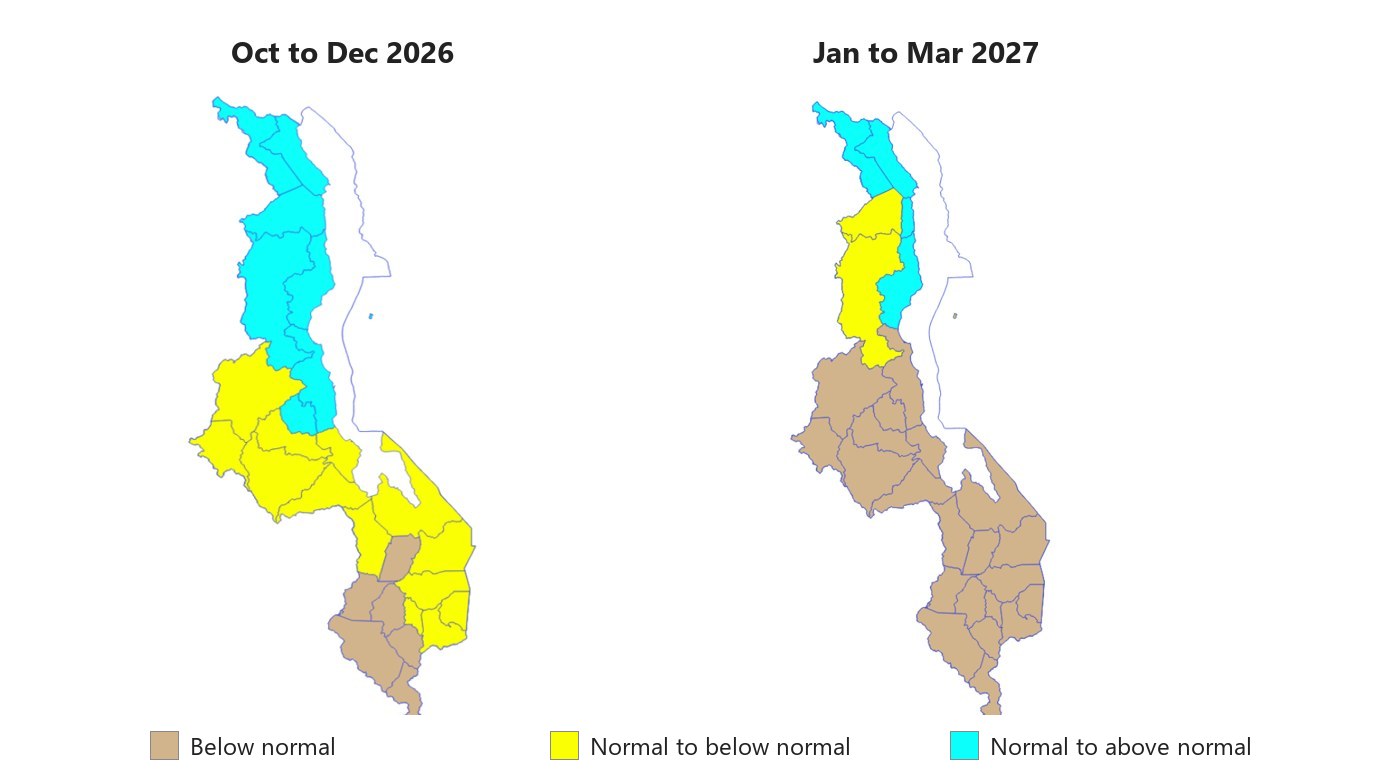
From the DCCMS press release and seasonal climate outlook of 2 September 2026. “Normal” means close to the average rainfall for that area.
Northern region
Normal to wetter than normal
Central region
Drier than normal, most of all from January
Southern region
The driest part of the country
DCCMS says the risk of below normal rain from October to December is highest in the Shire Valley, Thyolo, Blantyre, Mwanza, Neno and Balaka. Hotter than normal days are expected across the whole country, with a higher chance of heatwaves.
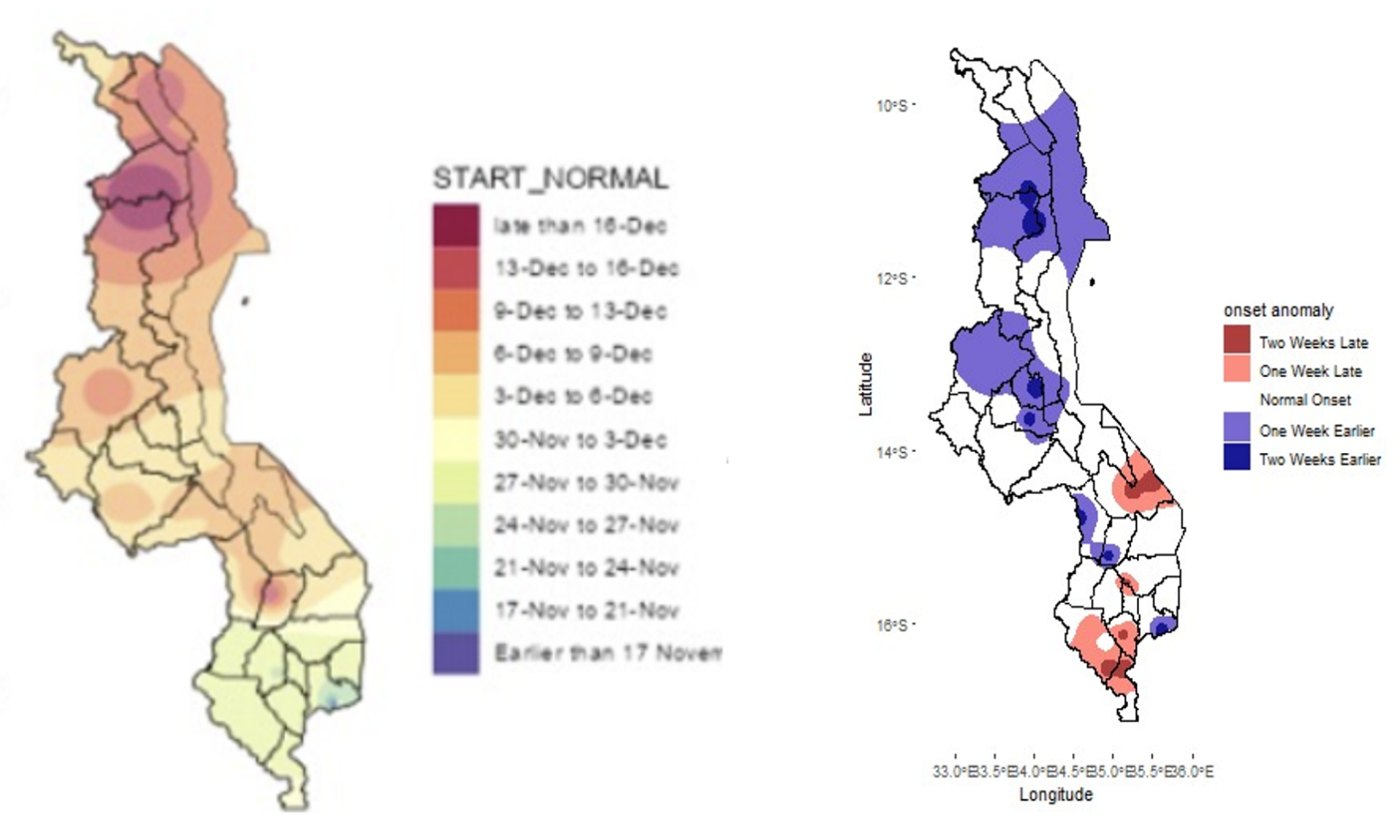
When the rains start, stop and dry up
The rains in Malawi run from October to April. They usually arrive in the south first and move north.
-
October to November: first showers, not yet the real rains
October is expected to bring less than 50 mm in most areas. The first showers, chizimalupsya, usually fall before the established rains. November should bring 50 to 150 mm, more in the north.
-
Mid-December: the established rains
DCCMS expects established rains from about mid-December in most of the country. December should be the wettest month in every region, with averages of about 254 mm in the north, 249 mm in the centre and 209 mm in the south.
-
January and February: the dry spell risk
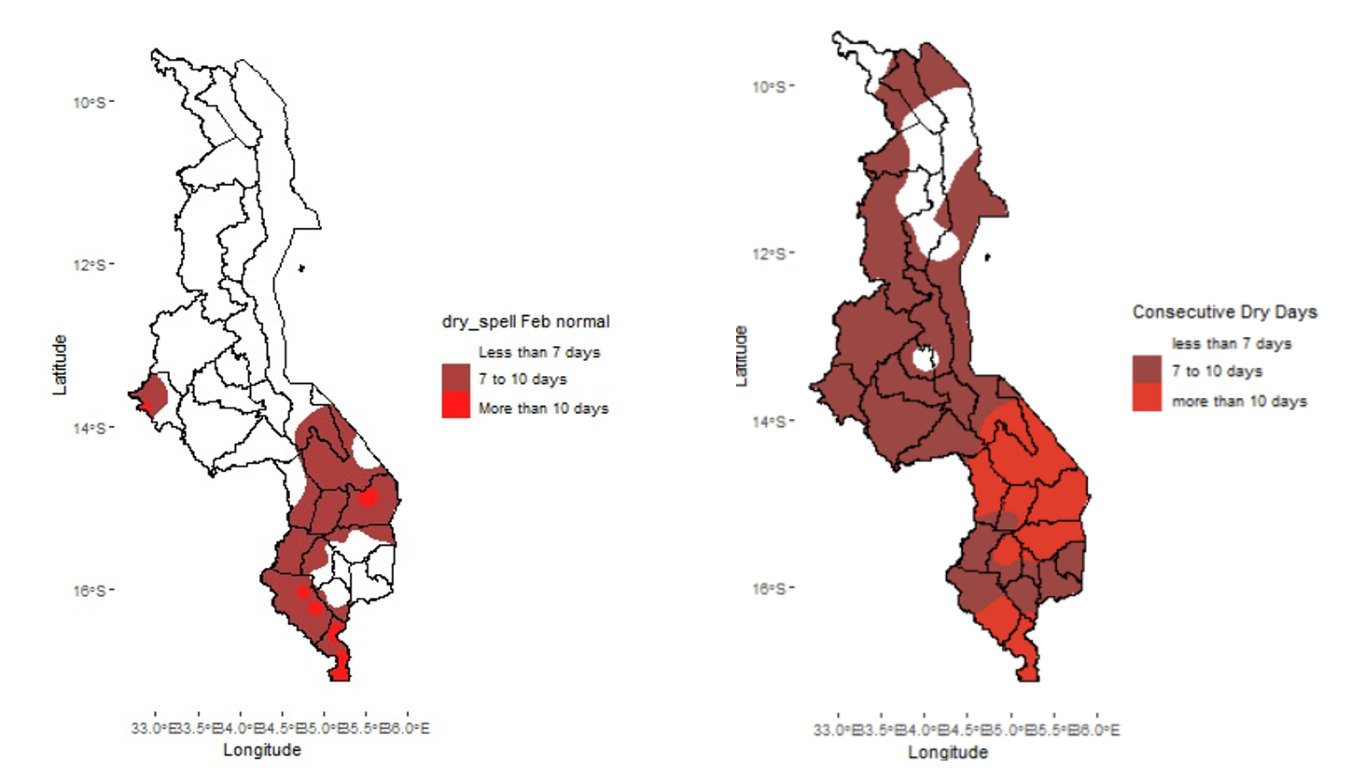
Dry spells of about a week are possible in many areas in January; in the south they may last 7 to 10 days, and more than 10 in the Lower Shire. February carries the biggest risk: dry spells of more than 10 days over much of southern Malawi, at the time crops need water most.
-
March and April: the rains tail off
The rains should end in the last week of March in the south, the first week of April in the centre and the second week of April in the north. April should be dry in the centre and south (about 45 mm), wetter in the north (about 120 mm).
Why this season is expected to be dry
From the DCCMS bulletin.
El Niño is a warming of the sea in the middle and east of the Pacific Ocean. It changes wind patterns around the world and usually means less rain in southern Africa, including southern Malawi. DCCMS says El Niño had already formed by August 2026, and models give a more than 90% chance that a strong El Niño lasts through the season.
The Indian Ocean Dipole, the difference in sea temperature between the west and east of the Indian Ocean, is also expected to be positive. Together the two are linked with below normal and erratic rain. DCCMS compares this season with 1982/83, 1997/98, 2015/16 and 2023/24. The 2015/16 drought left about 6.7 million Malawians short of food, and 2023/24 about 4.2 million.
- Driver
- Strong El Niño
- Chance
- Over 90%
- Similar seasons
- 2015/16, 2023/24
- Issued
- 2 Sept 2026
What the forecast means for your crops
DCCMS’s own advice in the outlook, plus where to get local help.
-
Expect lower harvests in the south and centre
DCCMS’s first estimate is that crops in southern and central Malawi will get only 60% to 80% of the water they need, and that production could be 13% to 31% lower than in 2025/26. The north is expected to do better. These are early estimates that DCCMS will update during the season.
-
Choose drought tolerant and early maturing seed
The outlook asks farmers to use drought tolerant and early maturing crops, because a late start and dry spells shorten the real growing season. Your agriculture extension officer can tell you which varieties suit your area.
-
Save water and soil moisture
DCCMS recommends water conservation and rainwater harvesting, and small water stores for crops, homes and animals. In the north, where heavy rain is possible, keep drains open and protect soil from erosion.
-
Follow the short forecasts during the season
A seasonal forecast cannot tell you the weather on a given day. DCCMS publishes daily, five-day and 10-day agrometeorological bulletins and warnings through the season. For today and the next 7 days in your town, use the Zaku weather tool.
Today’s weather
Now in four cities. For any of 44 towns and the next 7 days, open the weather tool.
- Lilongwe27°27° / 22°
- Blantyre30°30° / 24°
- Mzuzu25°25° / 20°
- Zomba29°29° / 22°
District forecasts from DCCMS
DCCMS made a one-page forecast for each of the 28 districts (in Chichewa), with expected rain each month, when the rains start and dry spells. Tap your district to open it on metmalawi.gov.mw.
Northern region
Central region
Southern region
DCCMS links
Rainy season FAQ
When will the rains start in Malawi in 2026?
DCCMS expects established rains from about mid-December 2026 in most of the country. The start is expected to be significantly late in the south, slightly late in the centre and on time in the north. Light first showers (chizimalupsya) come earlier.
Will 2026/27 be a drought year?
DCCMS expects below normal rain in southern and central Malawi, mainly from January to March, and long dry spells in January and February. It also says this does not mean the whole country will have a drought: some areas may get near normal rain.
Is it an El Niño year?
Yes. DCCMS says El Niño had formed by August 2026 and there is a more than 90% chance that a strong El Niño lasts through the season.
Which areas will get the most rain?
The north, especially Karonga, Chitipa and Nkhata Bay, plus the central lakeshore early in the season. Heavy rain there can cause waterlogging and local floods.
When will the rains end?
In the last week of March in the south, the first week of April in the centre and the second week of April in most of the north.
Where do I find the forecast for my district?
DCCMS published a one-page forecast for each of the 28 districts on metmalawi.gov.mw. The links are in the district section of this page.
Does this forecast tell me tomorrow’s weather?
No. It shows the likely pattern over months. For daily weather use the DCCMS daily and 10-day bulletins or the Zaku weather tool, which covers 44 towns.
Will the forecast change?
DCCMS updates its information during the season through weekly and 10-day bulletins and issues warnings for extreme weather. We will update this page if DCCMS revises the outlook.
Related
Sources: Department of Climate Change and Meteorological Services (DCCMS), Ministry of Natural Resources: press release and 2026/2027 Seasonal Climate Outlook issued 2 September 2026, and the 2026/2027 Seasonal Climate Outlook bulletin; district downscaled seasonal forecasts 2026-2027 (September 2026); DCCMS Facebook page. Checked 24 October 2026. Maps from the DCCMS bulletin (legend redrawn).