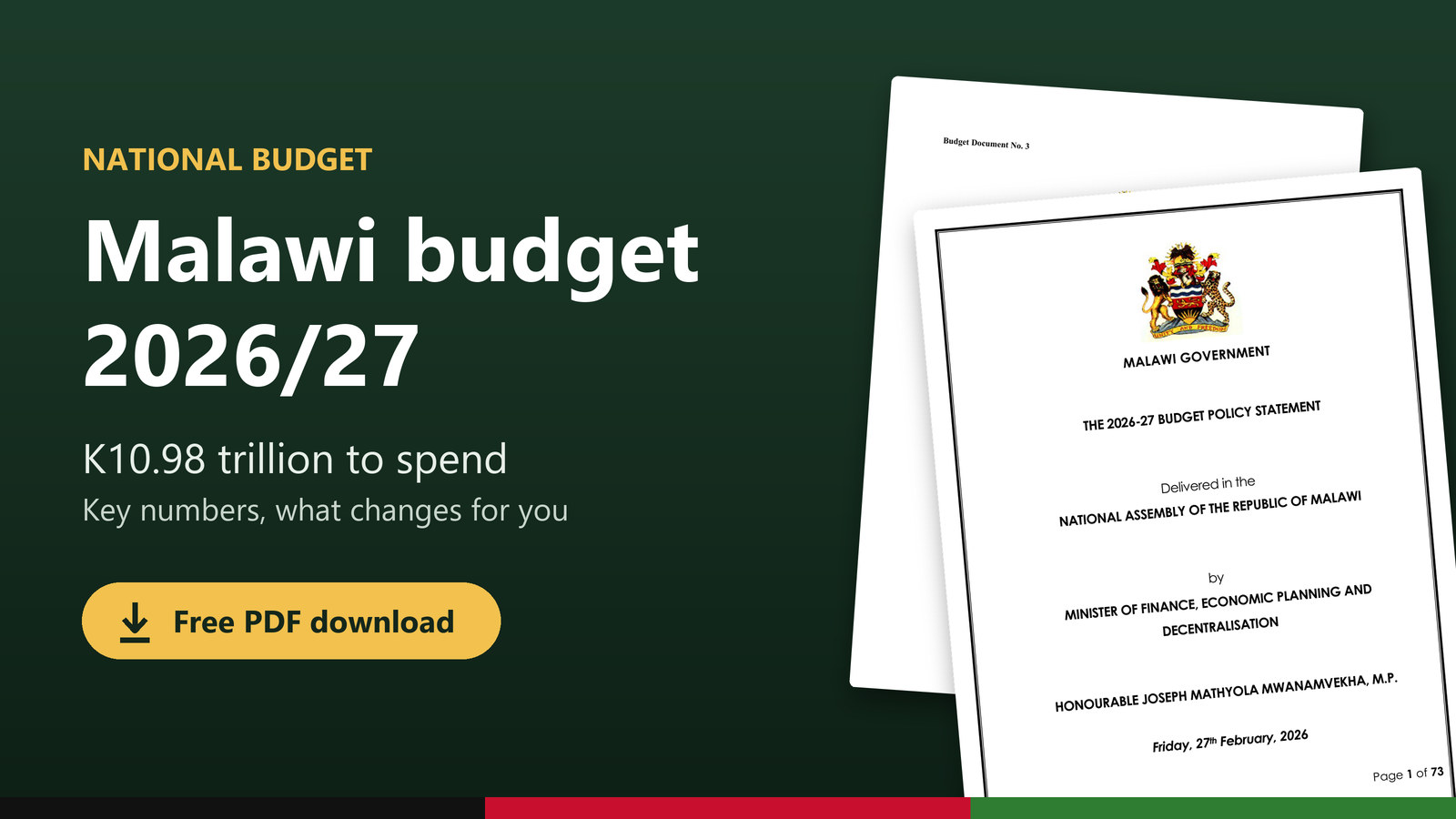
Malawi national budget 2026/27
Where the K10.98 trillion comes from and where it goes, the tax changes that touch your pocket, how much CDF each council gets, and the full official budget to download free.
- Spending: K10.98 trillion
- Borrowing: K2.85 trillion
- CDF: K5 billion per constituency
Quick answer: Malawi’s 2026/27 budget plans to spend K10.978 trillion from 1 April 2026 to 31 March 2027. Finance Minister Joseph Mwanamvekha presented it on 27 February 2026 and Parliament passed it in March. Government expects K8.126 trillion in taxes, grants and fees and plans to borrow the other K2.852 trillion (9% of GDP). The biggest single cost is interest on debt: K2.793 trillion, more than education and health put together. New this year: K5 billion CDF per constituency, free public primary and secondary school fees, VAT on foreign digital services such as Netflix, and a higher VAT registration line of K50 million.
Download the 2026/27 budget (PDF)
The official Ministry of Finance documents, unchanged. Tap to open or save.
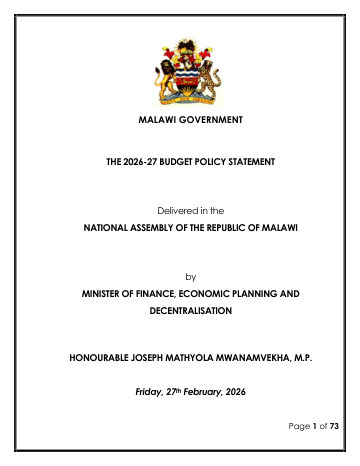 2026/27 Budget StatementThe Minister’s speech to Parliament, 27 February 2026. 73 pages, 0.3 MB. Start here.Download PDF
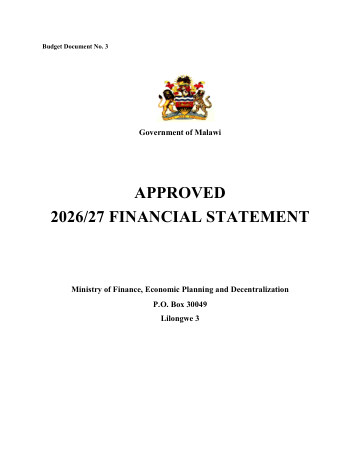 Approved 2026/27 Financial StatementBudget Document No. 3: every revenue and spending line, debt, CDF by council. 146 pages, 2 MB.Download PDF
Other budget books (ministry-by-ministry estimates, project lists) are on the Ministry of Finance website under Documents. They are large files, so use Wi-Fi.
What do you want to know?
Tap a card to jump to it.
The 2026/27 budget in numbers
Approved totals, in kwacha. The financial year runs 1 April 2026 to 31 March 2027.
Income
Where the money comes from
Spending
Where the money goes
Wages, interest, pensions and other fixed bills that must be paid by law add up to K5.092 trillion, or 78.9% of everything Malawi collects itself. Last year it was 97.5%, which left almost nothing for anything else.
What the budget assumes about the economy
If these miss, the numbers change at the mid-year review.
What changes for households and small businesses
Customs and excise changes started at midnight on 27 February 2026. Income tax and VAT changes were set for 1 April 2026, once Parliament passed the tax bills.
Cheaper or tax free
- Disability devices, adapted cars, hearing aids
- Bibles, the Qur’an and religious audio
- Greenhouses
- Tools for community technical colleges
- Generators over 75 KVA for schools and hospitals
More tax
- Imported eggs and chicken (30% surcharge)
- Imported vegetables (40%) and fruit (15%)
- Powdered drink sachets (20% excise)
- Watches, perfume, jewellery, game consoles
- Hybrid cars over 1500cc (10% or 20% excise)
PAYE bands did not change in this budget. See our PAYE tax bands guide and calculator for what comes off your salary.
How much CDF does my council get?
The reformed CDF starts with K1.145 trillion: K5 billion for each of the 229 constituencies, paid through local councils. From the approved Financial Statement.
Each constituency
Where K5 billion is meant to go
- PurposePer constituency
- Building and repairsK3.6 billion
- District-wide projectsK500 million
- Project managementK250 million
- Disaster repairsK250 million
- School bursariesK150 million
- Women empowermentK100 million
- Youth empowermentK100 million
- Sports and creative artsK50 million
By council
CDF for every council
Cities (135 billion)
- Lilongwe City12 constituenciesK60 billion
- Blantyre City10 constituenciesK50 billion
- Mzuzu City3 constituenciesK15 billion
- Zomba City2 constituenciesK10 billion
Towns and municipalities (20 billion)
- Kasungu Municipal1 constituencyK5 billion
- Luchenza Municipal1 constituencyK5 billion
- Mangochi Municipal1 constituencyK5 billion
- Karonga Town1 constituencyK5 billion
Northern Region districts (170 billion)
- M’mbelwa13 constituenciesK65 billion
- Nkhata Bay6 constituenciesK30 billion
- Chitipa5 constituenciesK25 billion
- Karonga5 constituenciesK25 billion
- Rumphi4 constituenciesK20 billion
- Likoma1 constituencyK5 billion
Central Region districts (400 billion)
- Lilongwe19 constituenciesK95 billion
- Dedza10 constituenciesK50 billion
- Dowa10 constituenciesK50 billion
- Kasungu10 constituenciesK50 billion
- Ntcheu8 constituenciesK40 billion
- Mchinji7 constituenciesK35 billion
- Salima6 constituenciesK30 billion
- Nkhotakota5 constituenciesK25 billion
- Ntchisi5 constituenciesK25 billion
Southern Region districts (420 billion)
- Mangochi12 constituenciesK60 billion
- Mulanje9 constituenciesK45 billion
- Zomba9 constituenciesK45 billion
- Machinga8 constituenciesK40 billion
- Thyolo8 constituenciesK40 billion
- Chikwawa7 constituenciesK35 billion
- Blantyre6 constituenciesK30 billion
- Balaka5 constituenciesK25 billion
- Chiradzulu5 constituenciesK25 billion
- Nsanje5 constituenciesK25 billion
- Phalombe5 constituenciesK25 billion
- Neno3 constituenciesK15 billion
- Mwanza2 constituenciesK10 billion
CDF guidelines were still being finalised when the budget was presented. Ask your MP or council what projects are planned for your constituency.
Where the sector money goes
Sector totals include wages and running costs, so they overlap with the spending list above.
Education: K1.28 trillion
K31.7 billion for free secondary school fees and K15.9 billion for free primary school fees. K11.3 billion for free exams and student IDs, K11 billion for teaching and learning materials. K234.3 billion for the six public universities, where students who can afford it will pay cost-reflective fees. K42 billion in loans and upkeep for 40,000 university students, K4.5 billion for graduate internships.
Health: K1.02 trillion
K108.3 billion for medicines (K58.3 billion central hospitals, K50 billion district hospitals), plus K20 billion towards old debts to Central Medical Stores. K3 billion to start dialysis centres, beginning at Mzuzu Central Hospital. K11 billion for blood transfusion, K3 billion for treatment abroad, K1 billion for ambulances. Paying wards are being opened in all central and district hospitals. Construction of Blantyre and Chikwawa district hospitals starts this year.
Agriculture: K931.1 billion
K111.45 billion for the fertiliser subsidy, K11.3 billion for locally produced maize seed, K60 billion to restock the Strategic Grain Reserve and K60 billion for ADMARC to buy maize and other crops. K40 billion for the National Irrigation Development Programme and K241.1 billion for the Shire Valley Transformation Project. K14 billion for mega farms.
Roads, rail and airports: K664.4 billion
Work continues on the M1 (Kamuzu International Airport turn-off to Chiweta) and the M5 (Kaphatenga to Dwangwa), with more than 20 other roads listed. Plans include rehabilitating Kamuzu International and Bakili Muluzi airports, designs for a new Mzuzu airport, advance works on the Kanengo to Mchinji railway, finishing Likoma Port and upgrading Chipoka Port.
Social protection
K7 billion for the Social Cash Transfer Programme, up 58.6%, with plans to reach Mwanza, Neno, Ntchisi and Nkhotakota. K2 billion for the Disability Trust Fund and K1 billion for the National Children’s Commission.
Tourism, mining and manufacturing
K17 billion to start the Malawi Mining Company (MAMICO) and K5.6 billion for the new mining regulator. K7.4 billion for special economic zones (Chigumula, Magwero, Matindi, Dunduzu), K4.6 billion for tourism promotion, Kasungu National Park and public beaches, and K500 million for designs of the Salima Integrated Tourism Resort.
Why so much goes on interest
In the Minister’s own words, the debt is ‘unsustainable’.
Malawi owed K23.9 trillion at the end of December 2025, equal to 90.9% of the whole economy. About 65% of it, K16 trillion, is owed to lenders inside Malawi, mostly through Treasury bills and bonds. Domestic loans carry high interest, which is why interest (K2.793 trillion) is now bigger than the education and health budgets combined (K2.3 trillion).
The budget plans to borrow K2.662 trillion locally this year and says government is restructuring both domestic and foreign debt to bring interest costs down. For how fast that borrowing is going, see our news report on K2 trillion raised in Treasury bills in six months.
- Total debt
- K23.9 trillion
- Share of GDP
- 90.9%
- Owed locally
- K16 trillion
- Local borrowing 2026/27
- K2.662 trillion
Spending cuts that stay in force
The November 2025 austerity measures continue through 2026/27.
Budget 2026/27 FAQ
How big is Malawi’s 2026/27 budget?
K10.978 trillion, or 34.8% of GDP. K7.581 trillion is for recurrent spending (wages, interest, running costs) and K3.397 trillion for development projects.
Who presented the 2026/27 budget?
Finance Minister Joseph Mwanamvekha presented it to the National Assembly on Friday 27 February 2026. Parliament passed it in March 2026.
When does the 2026/27 financial year start and end?
It runs from 1 April 2026 to 31 March 2027.
How much is Malawi borrowing in 2026/27?
The deficit is K2.852 trillion (9% of GDP). Net borrowing is K2.662 trillion from local lenders and K190 billion from abroad.
How much CDF does each constituency get?
K5 billion per constituency, K1.145 trillion in total across 229 constituencies, from 1 April 2026.
Did PAYE change in the 2026/27 budget?
No. The budget did not change the PAYE bands. It changed VAT registration, betting, rental and share-sale taxes.
Is VAT charged on Netflix and YouTube in Malawi?
The 2026/27 budget introduced VAT on digital services supplied by foreign companies, naming Netflix, Facebook and YouTube as examples, through a separate bill.
Where can I download the 2026/27 budget?
Use the download buttons at the top of this page for the Budget Statement and the approved Financial Statement. All budget books are also on the Ministry of Finance website, finance.gov.mw.
Related guides
Sources: Ministry of Finance, Economic Planning and Decentralisation (finance.gov.mw): The 2026-27 Budget Policy Statement (27 February 2026) and the Approved 2026/27 Financial Statement, Budget Document No. 3 (CDF by council, borrowing split). Percentage shares in the charts are our arithmetic on those figures.