
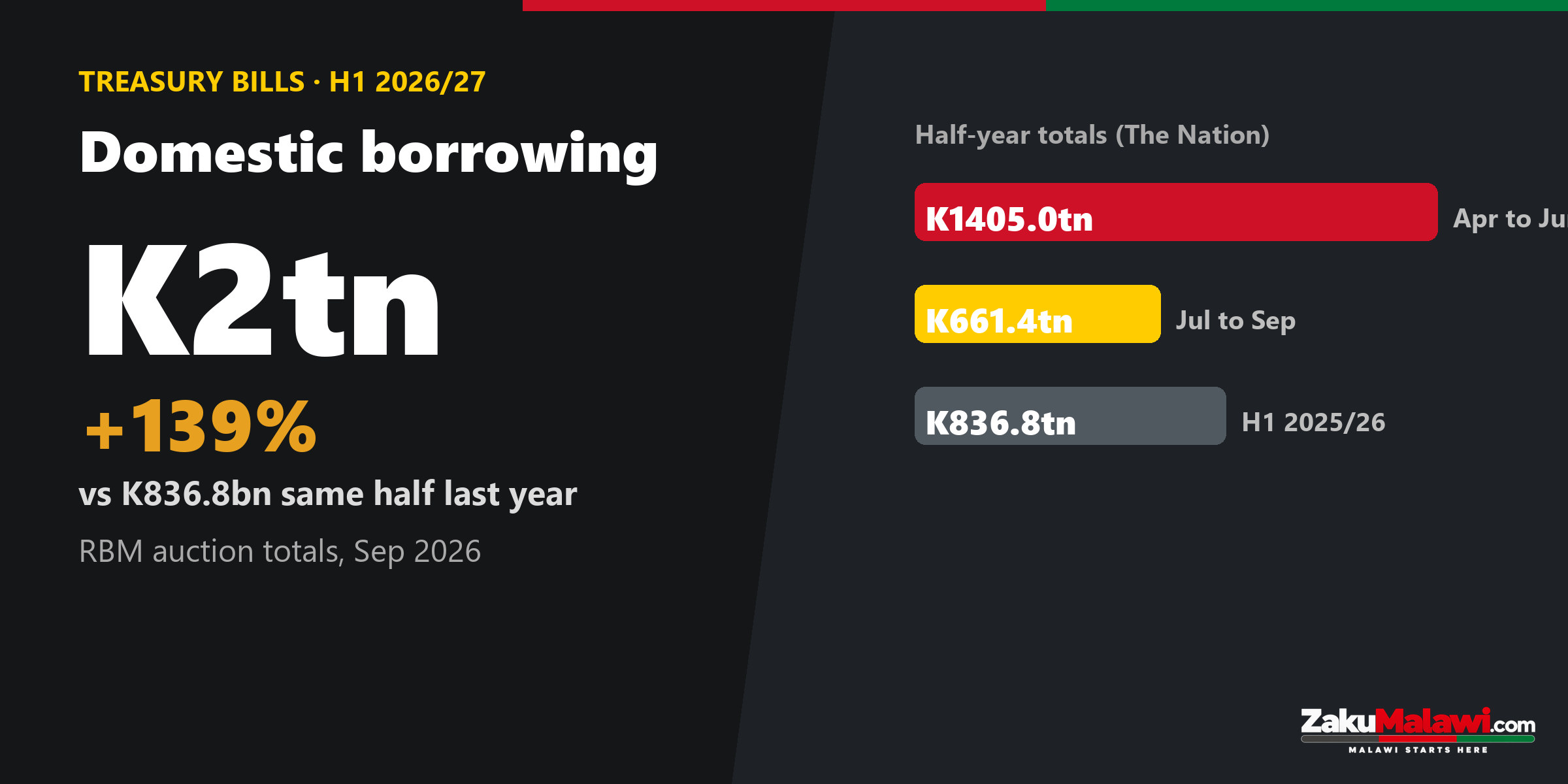
Malawi government raised about K2 trillion through Treasury bills alone in the first half of the 2026/27 financial year, according to monthly auction totals published on the Reserve Bank of Malawi (RBM) website.
The Nation on Monday, 23 November 2026, tallied those RBM results and said the pace could push domestic borrowing past the K2.662 trillion target set for the full year. Analysts quoted in the paper warned about pressure on the budget deficit and debt costs.
Key facts
- RBM posts auction amounts raised after each Treasury bill sale
- June 2026 alone accounted for about 38% of the half-year total, The Nation reported
- 180-day yields edged up to 15% and 364-day to 16.5% in June auctions, according to the paper
- World Bank data cited by The Nation put the 2026/27 fiscal deficit at 11.8% of GDP, above the 9% budget figure
How the half year splits
The Nation grouped RBM auction totals by quarter:
| Period | T-Bills raised | Share of half year |
|---|---|---|
| April to June 2026 | K1.405 trillion | About 68% |
| July to September 2026 | K661.4 billion | About 32% |
| Same half 2025/26 | K836.8 billion | Baseline for comparison |
What analysts said
Raising K2 trillion through Treasury bills in six months suggests government is under significant pressure to finance spending.
Velli NyirongoEconomic analyst
With most revenue already committed to wages, pensions and interest, there is very little fiscal space left for development spending.
Bertha Bangara-ChikadzaEconomics Association of Malawi president
Excessive borrowing could suffocate the economy when debt levels are already unsustainable.
Bertha PhiriMalawi Economic Justice Network
All three spoke to The Nation for its 23 November 2026 report. The paper also said Parliament had postponed the mid-year budget review meeting. Treasury had not commented in that article.
Debt in context
The Nation cited estimates that total public debt is about K24 trillion, near 91% of GDP, with domestic debt at about K16 trillion. Malawi was among African countries with the largest projected fiscal deficits in 2026 in the World Bank’s Africa Economic Update, the paper said.
Read our 2026/27 national budget guide for spending plans and borrowing targets.