
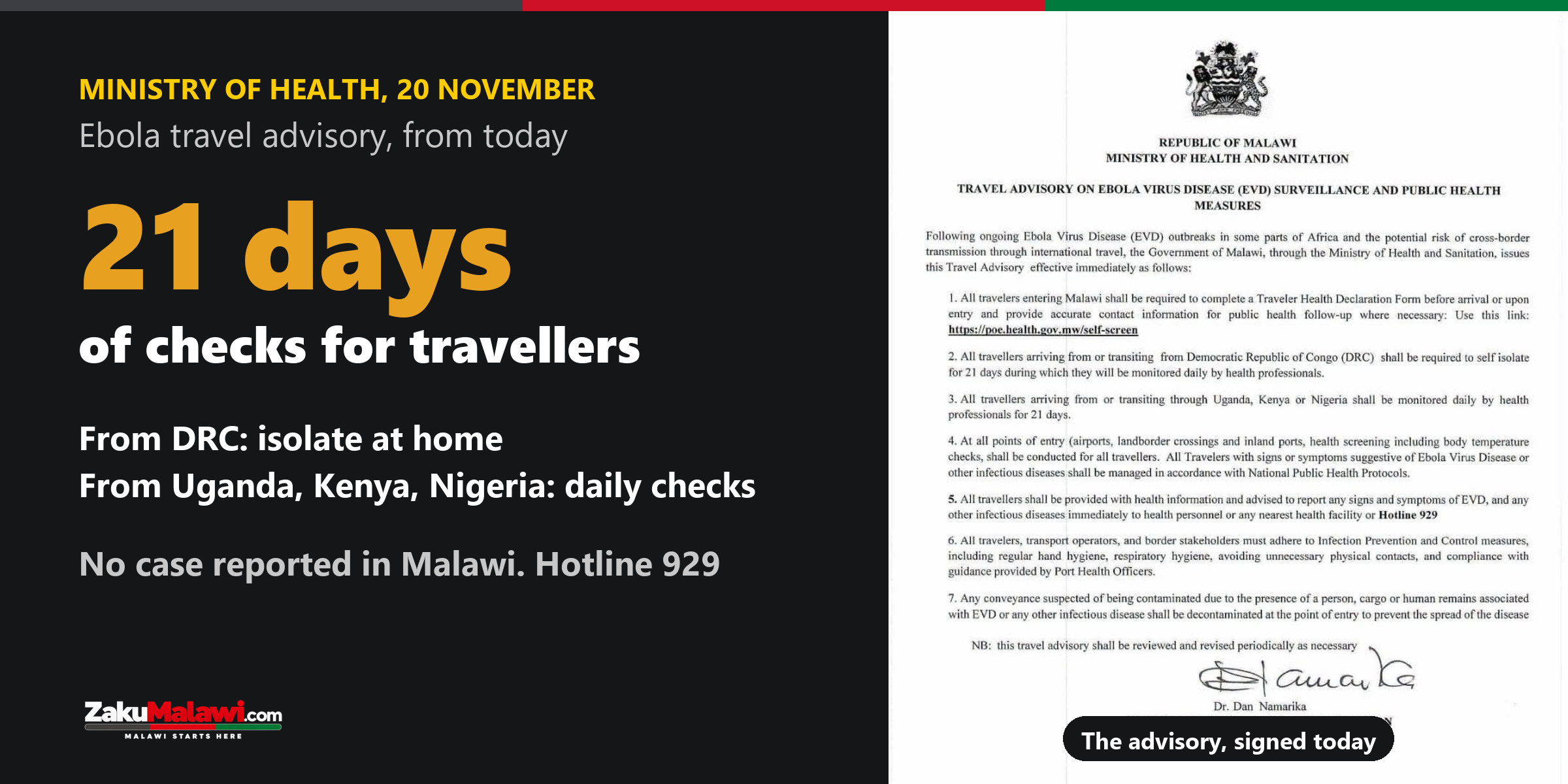
The Ministry of Health and Sanitation has brought in new Ebola checks for travellers, starting immediately. Anyone arriving from or through the Democratic Republic of Congo (DRC) must isolate for 21 days. Travellers from Uganda, Kenya or Nigeria will be checked on daily for 21 days.
No Ebola case has been reported in Malawi. The advisory, signed by Secretary for Health Dr Dan Namarika on Friday 20 November, aims to keep it that way, the Ministry said on Facebook.
Key facts
- From or through the DRC: isolate for 21 days, with daily health checks
- From or through Uganda, Kenya or Nigeria: daily health checks for 21 days
- Everyone entering Malawi: health form and temperature check
- Symptoms or questions: call the Ministry of Health hotline 929
Who the rules apply to
Isolate at home
DRC
Coming from or through the DRC: stay in isolation for 21 days. Health workers check on you every day.
Daily health checks
UgandaKenyaNigeria
Health workers check on you every day for 21 days. You do not have to isolate.
At the border
Every traveller
Fill in a health declaration form, give contact details, and have your temperature checked.
If you are travelling
Fill in the form before you travel
Use the Ministry’s self-screening form, or fill it in when you arrive. Give a number where health workers can reach you.
Expect a check at the border
Airports, land borders and lake ports will take everyone’s temperature.
Follow the Port Health Officers
Wash your hands often, cover coughs and avoid close contact.
Feel unwell later? Speak up
Report any symptoms to the nearest health facility or call 929.
Signs to watch for
Ebola usually starts like many common illnesses:
Fever
Tiredness
Muscle pain
Headache
Sore throat
It can get worse over the following days:
Vomiting and diarrhoea
Bleeding
Signs can appear any time from 2 to 21 days after contact, which is why the checks last 21 days. People cannot pass it on before they feel sick. It spreads through direct contact with the blood or body fluids of a sick person, or of someone who has died of it. The first signs look like malaria, so a test at a health facility is the only way to tell them apart, according to the World Health Organization.
Why now
The outbreak was declared in the DRC in May and is now the second-largest Ebola outbreak on record. It is caused by the Bundibugyo strain, for which there is no approved vaccine or medicine yet; trials began in the DRC in October.
DRC
11,114 cases, 5,433 deaths
Confirmed by 11 November. Still spreading in the north-east.
Kenya
9 cases, 2 deaths
The last patient left hospital on 11 November.
Nigeria
1 case
A traveller from Uganda, confirmed in Abuja in October.
Uganda
20 cases, 2 deaths
Brought under control in the middle of the year.
Figures are from the European Centre for Disease Prevention and Control’s 12 November update and the World Health Organization.
The advisory
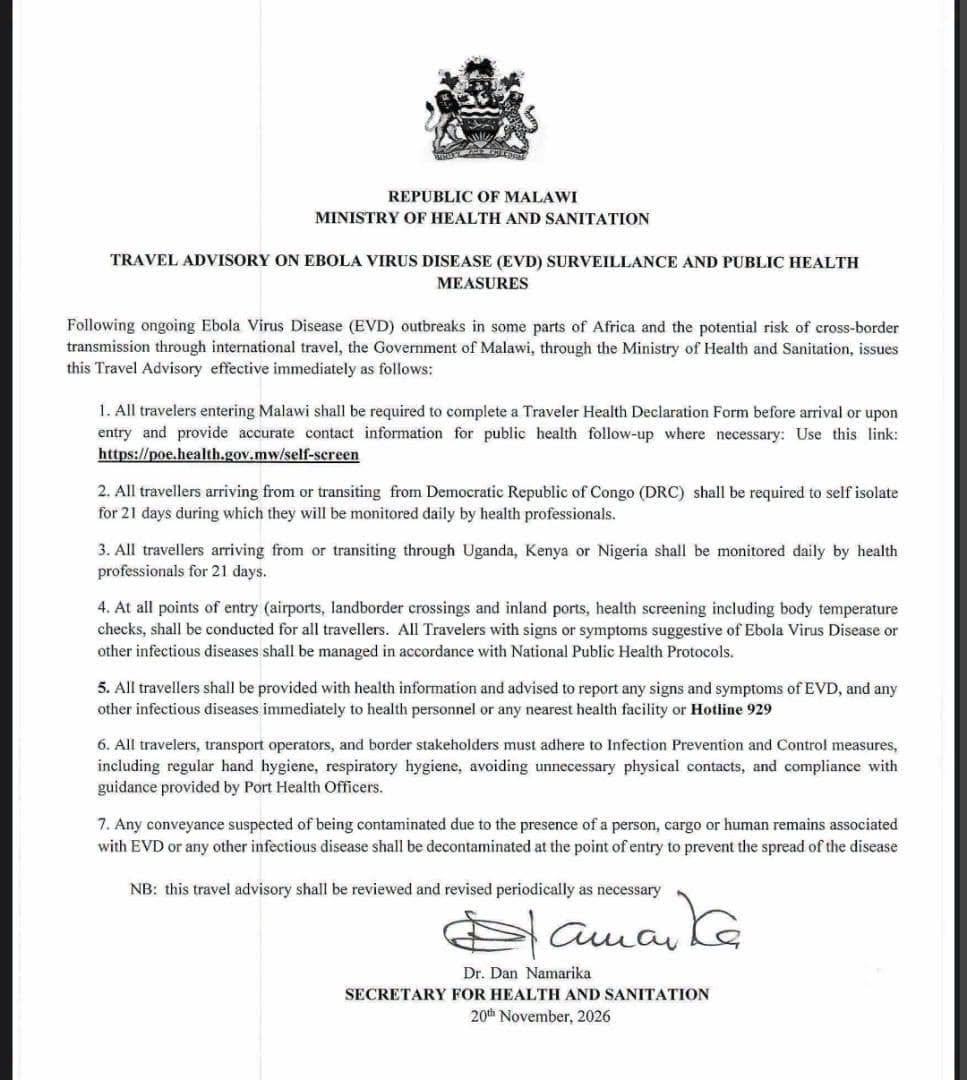
The Ministry says it will review the advisory as things change.