
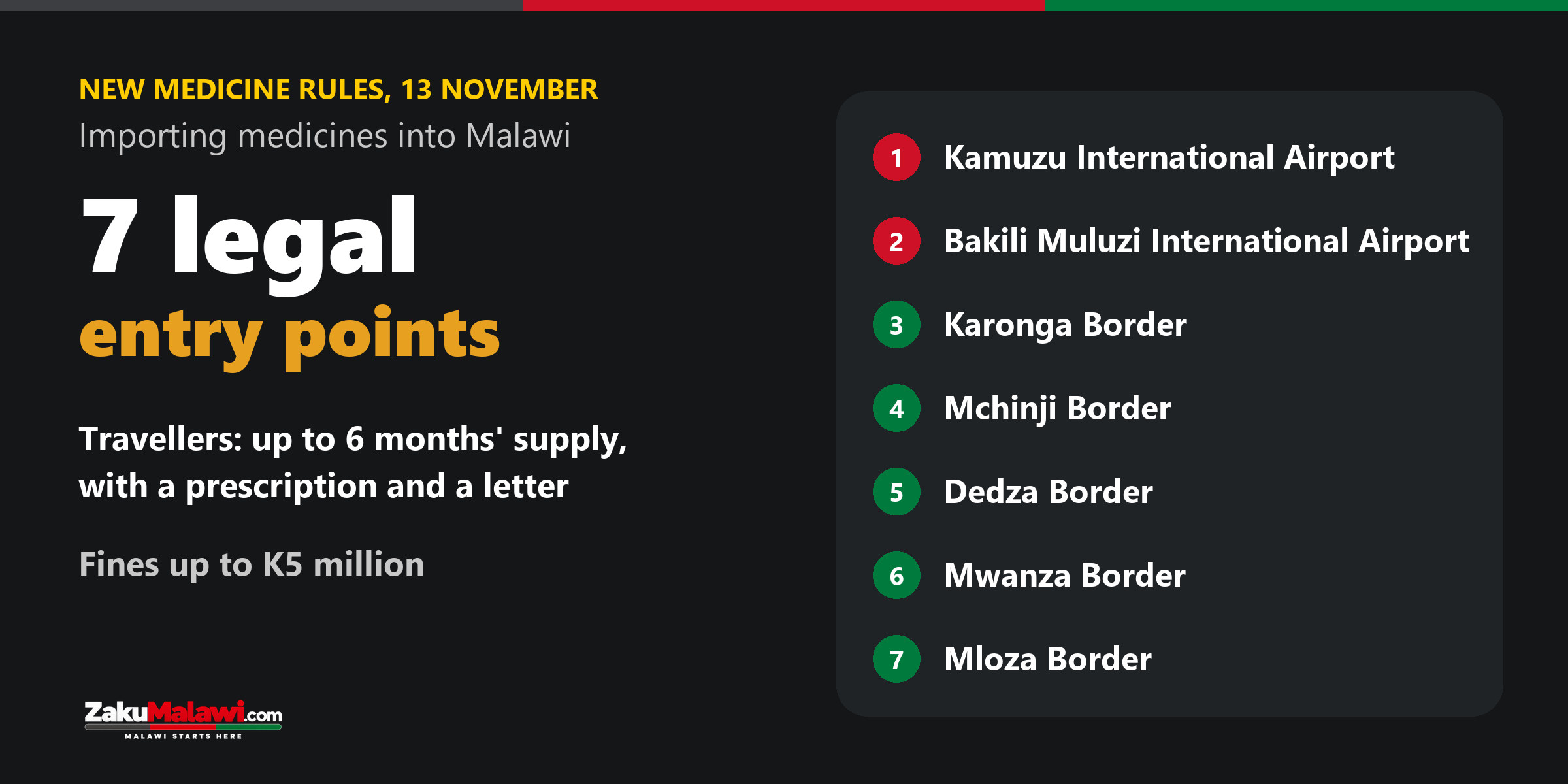
New rules on bringing medicines into and out of Malawi took effect on 13 November 2026, when three regulations were published in the Gazette, the Pharmacy and Medicines Regulatory Authority (PMRA) announced. They name seven places where medicines may lawfully enter or leave the country, set out who may import them, and say what travellers and patients must do.
Key facts
- In force from 13 November 2026: import rules (Government Notice 94), export rules (95) and entry points (96)
- Seven entry points: two international airports and five border posts
- Travellers may carry up to six months’ supply, with a prescription and a letter giving reasons
- Businesses need a wholesale licence and an import permit for every consignment
- Fines up to K5 million and up to five years in prison
If you are travelling
A visitor, or a Malawian coming home, may bring in enough medicine for six months of treatment for themselves or someone travelling with them. Carry a prescription from an authorised prescriber and a letter giving the reasons, unless the prescription says otherwise.
To order medicine from abroad for your own use, apply to PMRA through a registered pharmacy and attach a prescription. Medicine brought in this way cannot be sold.
The seven entry points
The entry points regulations list Kamuzu International Airport, Bakili Muluzi International Airport, and the Karonga, Mchinji, Dedza, Mwanza and Mloza border posts. Medicines cannot leave a port of entry until a PMRA inspector has checked and released them, and the Malawi Revenue Authority must not release a consignment unless the importer shows a valid PMRA import permit.
Who may import medicines
Under the import regulations, a business may bring in medicines only if it is run by a pharmacist registered with PMRA, holds a valid wholesale licence and has an import permit. Allied substances need the licence and the permit. Each permit covers one consignment and cannot be passed to anyone else, and PMRA has ten working days to decide on an application.
Doctors, dentists and vets may import for a patient or an animal through a pharmacy or vet shop, with PMRA approval. Only licensed manufacturers may import active pharmaceutical ingredients, the substance in a medicine that makes it work.
Penalties
MAXIMUM PENALTIES
| Bringing in a controlled drug without extra authorisation | K5 million + 5 years |
| Selling medicine brought in on a personal-use permit | K5 million + 5 years |
| Breaking the permit’s terms, or bringing in a different product | K4 million + 4 years |
| Bringing in more than the permit allows | K3 million + 3 years |
| False documents, or lending or altering a permit | K3 million + 3 years |
Fine and prison term on conviction. The court can also order the goods forfeited or destroyed.
An inspector who believes a consignment does not comply may detain it. PMRA can then order it destroyed or sent back at the importer’s cost, after giving the importer a chance to be heard.
Why it matters
PMRA says the rules are meant to keep falsified and substandard medicines out of the country and tighten control of the supply chain. The regulations were signed by Minister of Health and Sanitation Madalitso Baloyi.
Questions go to PMRA on 0111 755 165 or [email protected].