
Update, 17 November 2026: The Egenco board has suspended chief executive William Liabunya and company secretary Videlia Mluwira on full pay, citing preliminary findings on procurement, performance and the use of company resources. Read the update.
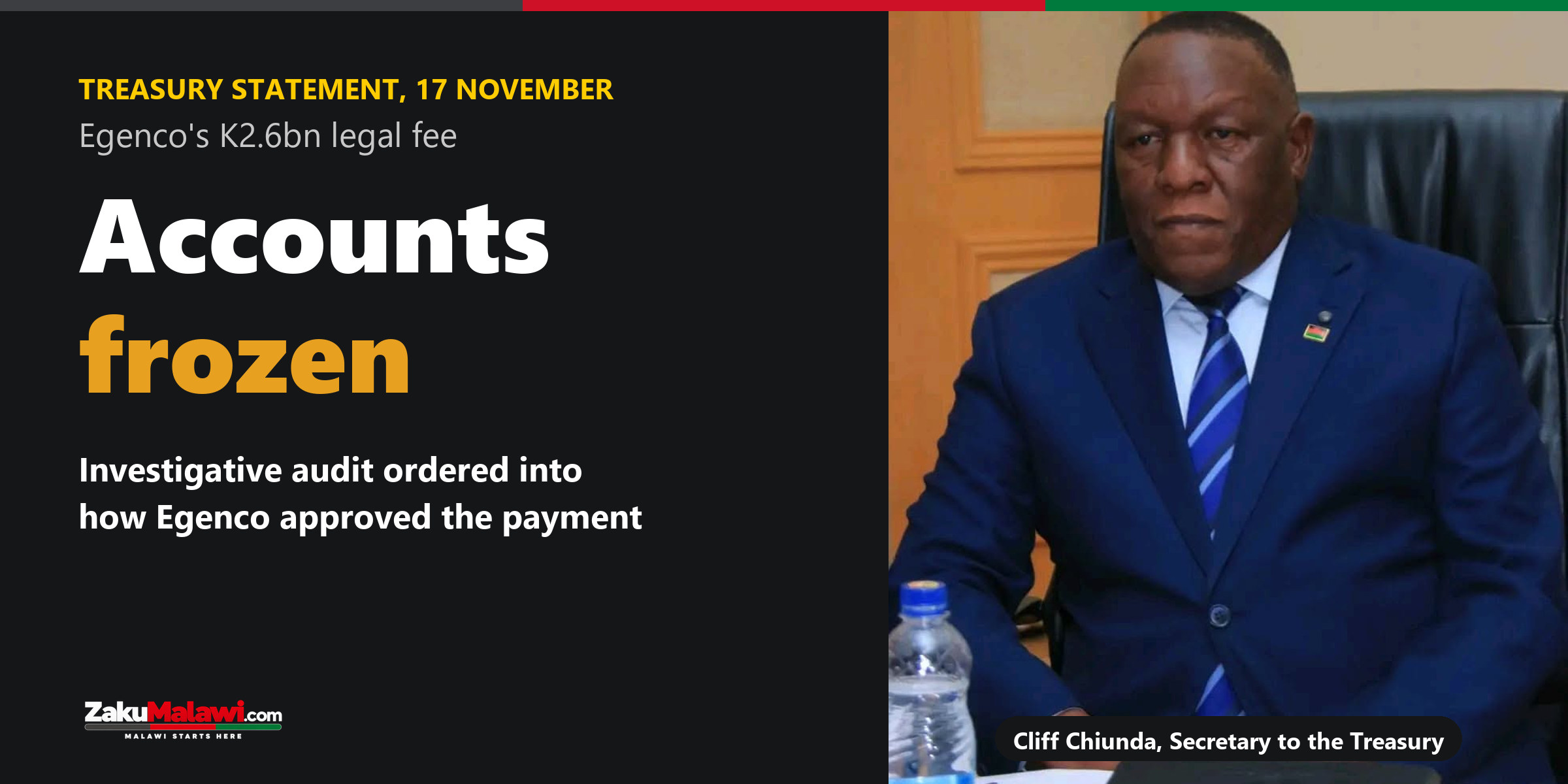
Government has frozen all the accounts linked to the K2.6 billion that the Electricity Generation Company (Egenco) paid to the law firm M&M Global Law Consultants, and has ordered an investigative audit into how Egenco approved the payment.
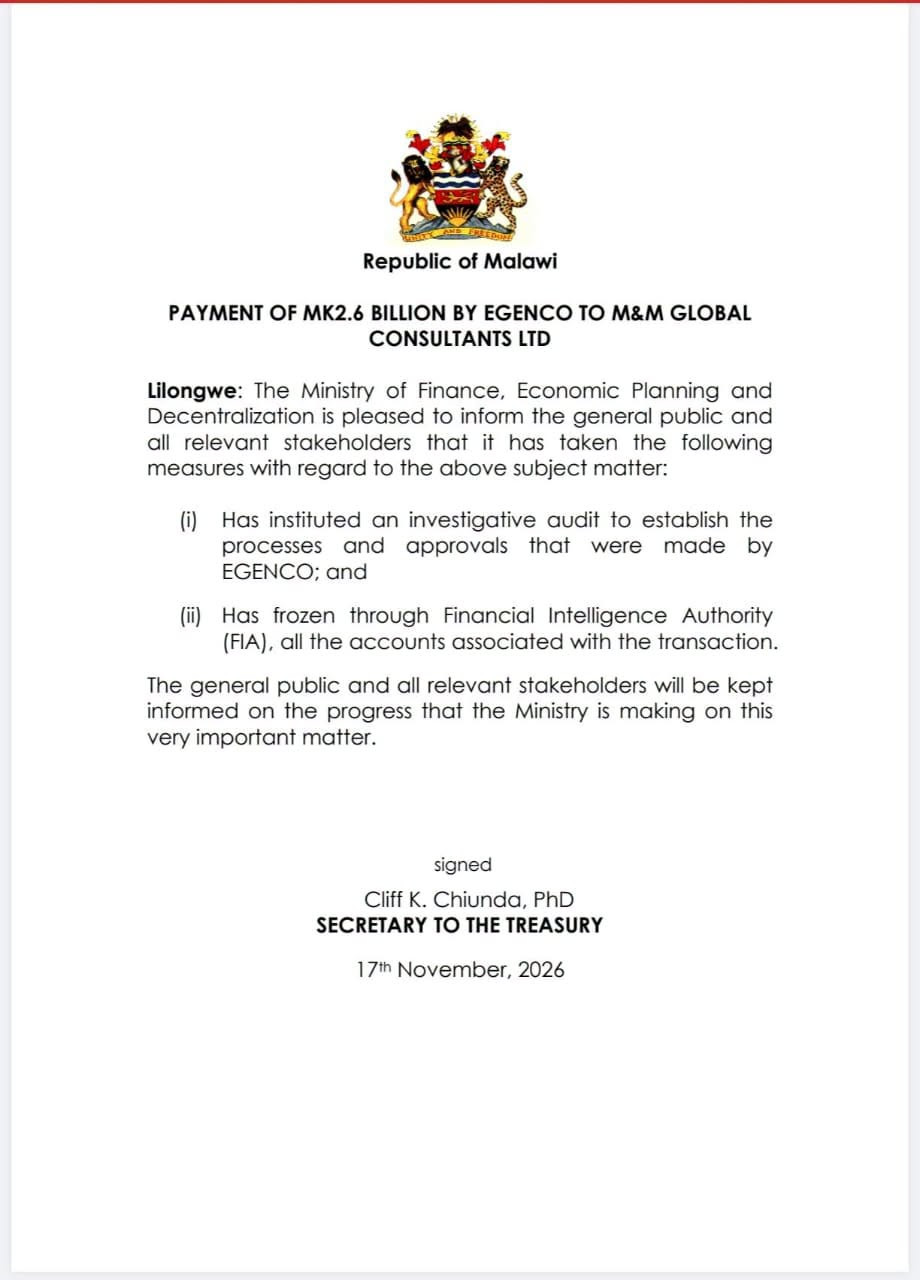
The Ministry of Finance announced both steps in a statement signed by Secretary to the Treasury Cliff Chiunda and dated 17 November 2026, which MBC Digital published. The accounts were frozen through the Financial Intelligence Authority (FIA). It came one day after Egenco defended the fee.
Key facts
- All accounts linked to the K2.6 billion transaction are frozen, through the FIA
- An investigative audit will look at the processes and approvals Egenco used
- Statement signed by Secretary to the Treasury Cliff Chiunda, 17 November 2026
- Egenco says the fee was legitimate: 15 percent of debt recovered from Escom, plus VAT
What Treasury said
The ministry said it had taken two measures. It “has instituted an investigative audit to establish the processes and approvals that were made by EGENCO” and “has frozen through Financial Intelligence Authority (FIA), all the accounts associated with the transaction”.
It promised to keep the public informed of progress on what it called “this very important matter”. The statement does not say which accounts are frozen, who will carry out the audit, or when it should finish.
How we got here
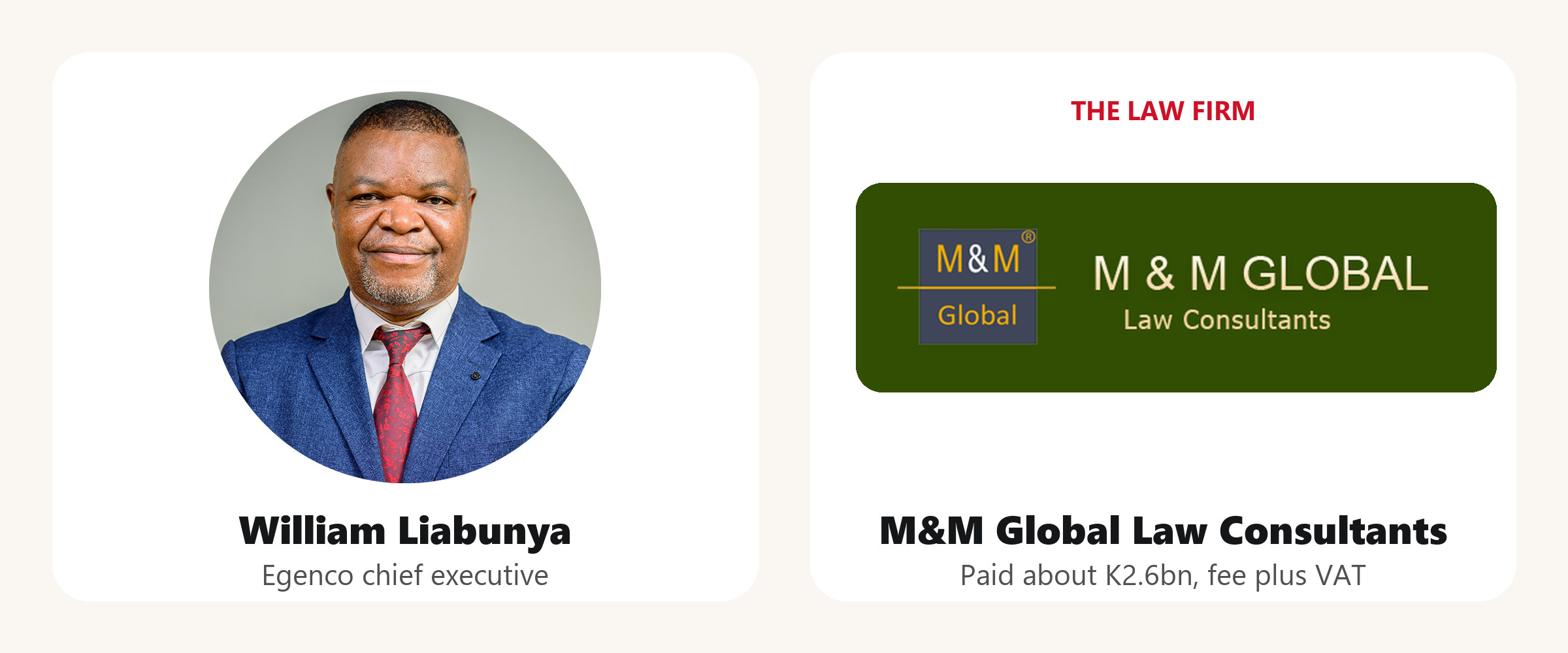
The payment became public through leaked documents and posts on social media, where lawyer and activist Alexious Kamangila, who has more than 200,000 followers on Facebook, was among the loudest voices. Egenco then confirmed it had paid M&M Global about K2.6 billion for helping it recover money owed by the Electricity Supply Corporation of Malawi (Escom). Both are state-owned companies.
In a statement on 16 November, Egenco chief executive William Liabunya said the firm was paid a 15 percent fee, about K2.2 billion, plus about K390 million in VAT, and denied claims that Egenco’s executives had personally benefited, Nyasa Times reported. Leaked documents showed a contract that set the firm’s fees at hourly rates, Malawi Voice reported; Egenco has not explained the difference.
The sums and the questions are in our first story: Egenco paid K2.6bn to collect a debt from Escom.
What a freeze means
The Financial Intelligence Authority is the body that tracks suspicious money in Malawi. A freeze means the banks holding the accounts must stop money leaving them while the matter is looked into. It is not a finding that anyone did anything wrong.
The audit is the bigger step. It will look at how the contract was signed and how the payment was approved inside Egenco, which is exactly what the public has been asking.
Online pressure, fast results
The speed stands out. The payment became a public row on social media; Egenco answered on 16 November, and Treasury froze the accounts on 17 November. Without the leak and the outcry online, it is not clear the payment would have been questioned at all.
What we still do not know
- Whose accounts are frozen? The statement says “all the accounts associated with the transaction”, but not whose.
- Has the money already moved? If some of it left the accounts before the freeze, the statement does not say how it will be traced.
- Who runs the audit, and when will it report? No auditor or deadline is named.
- What do Egenco and M&M Global say now? Neither had commented on the freeze when we published.