
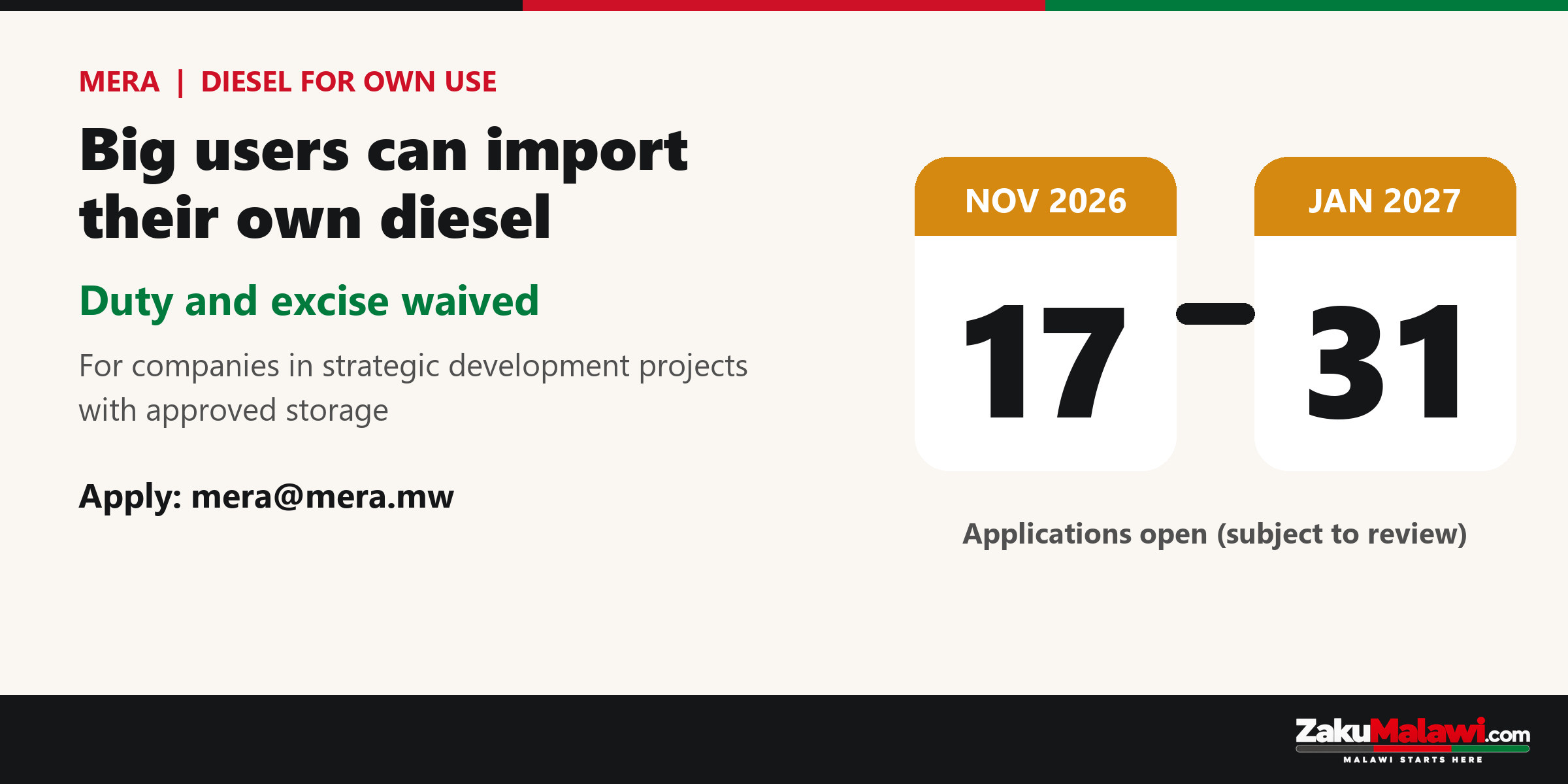
Companies that run big development projects and burn a lot of diesel can now apply to import their own diesel, without paying import duty or excise tax on it. The Malawi Energy Regulatory Authority (MERA) announced the offer on 16 November. It is open from 17 November 2026 to 31 January 2027, subject to review.
The fuel is for the company’s own use only, not for resale. MERA says the Ministry of Energy backs the policy and the Ministry of Finance is waiving the duty and excise.
Key facts
- Who can apply: companies in strategic development projects that rely on large amounts of diesel
- They need approved storage, or an approved arrangement to store it elsewhere
- Duty and excise are waived; the diesel is for their own use only
- Applications: 17 November 2026 to 31 January 2027, by email to [email protected]
What MERA announced
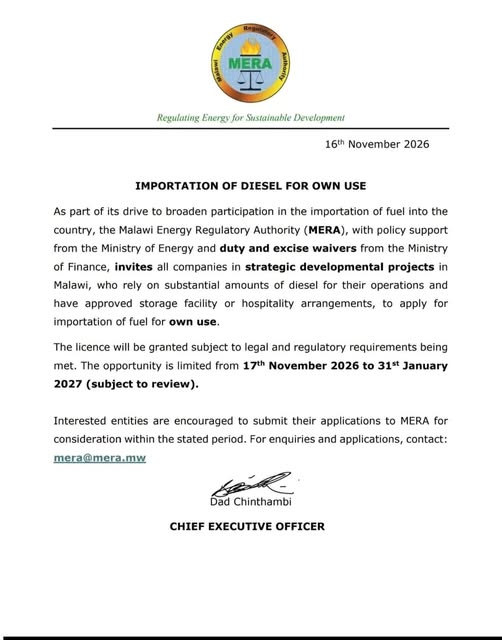
In the notice, signed by chief executive Dad Chinthambi, MERA says it wants to “broaden participation” in bringing fuel into the country. It invites companies in strategic developmental projects that depend on large amounts of diesel, and that have approved storage or hospitality arrangements, to apply for a licence to import fuel for their own use.
A licence will be granted only if the company meets the legal and regulatory requirements. Applications and questions go to [email protected].
Why MERA is doing this, in plain terms
This is our reading of the notice, based on what government and business have said on the record.
Fuel needs dollars. Malawi buys all its fuel from abroad, and importers pay in foreign currency. Forex has been scarce for months. Employers Consultative Association of Malawi executive director George Khaki told The Nation this week that a persistent shortage of foreign currency is stopping businesses from importing what they need.
Big users can bring their own. Mines, construction projects and large estates often have their own dollars or foreign partners. If they import their own diesel, they stop buying from the same limited supply as everyone else. In theory, that leaves more at the filling stations.
The waivers are the bait. Without the duty and excise waiver, importing their own diesel would cost companies more, and fewer would bother.
It is part of a wider push. On 16 November, Information Minister Shadric Namalomba told The Nation that government now allows individuals and businesses to import fuel directly instead of relying only on the National Oil Company of Malawi. MERA’s notice is the first detailed offer we have seen. Fuel and forex shortages are also behind the demonstrations planned for 17 November.
MERA does not explain “hospitality arrangements”. It most likely means storing the diesel in someone else’s approved depot when a company has no tanks of its own.

What it means at the pump
Nothing changes directly for ordinary drivers. You cannot apply, and the maximum price of diesel stays at K5,863 a litre. The only benefit to the public would come if big users stop drawing on the national supply, so that queues get shorter.
Questions the notice leaves open
- Who counts as “strategic”? The notice does not define a strategic developmental project, or say who decides.
- How much tax is given up? Duty and excise are paid on every litre sold at the pump. The notice does not say how much revenue the waiver will cost government.
- How will resale be stopped? Duty-free diesel is worth more sold on the side than used. Police and MERA arrested 77 people for illegal fuel trading between 10 October and 11 November, Malawi24 reported. The notice does not say how MERA will check that the fuel is used only by the company that imported it.
- Will it be extended? The window ends on 31 January 2027, “subject to review”.
Check today’s maximum pump prices in our guide to fuel prices in Malawi.