
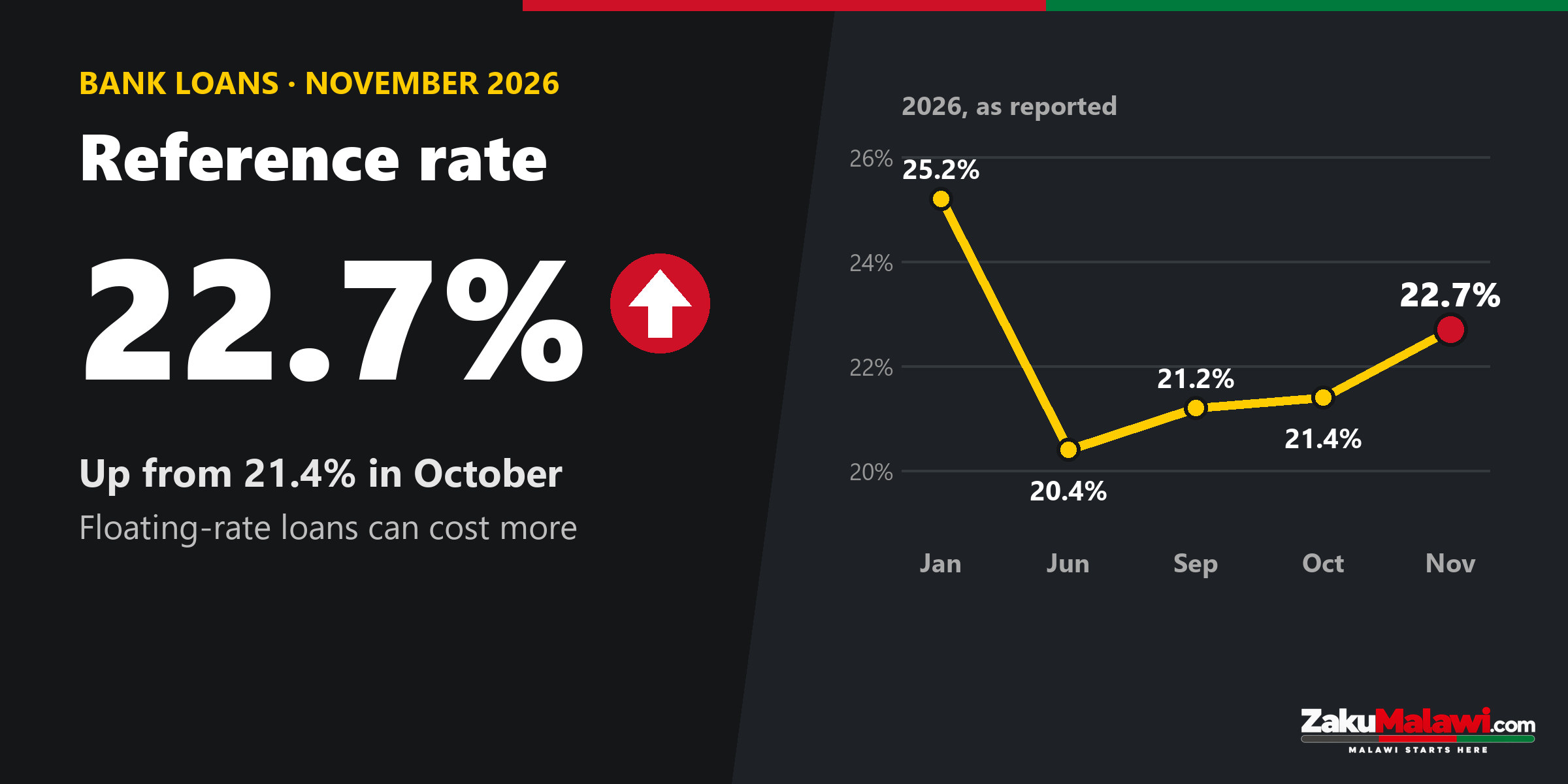
Commercial banks have raised the reference rate to about 22.7 percent for November, up from 21.4 percent in October, The Times reported. The new rate has applied since 4 November.
Banks price most loans as the reference rate plus a margin. So when it goes up, floating-rate loans and overdrafts get dearer. The rise is up to 1.3 percentage points in a month.
Key facts
- November reference rate: 22.6 to 22.7 percent, depending on the bank, from 4 November
- October: 21.4 percent
- It fell from 25.2 percent in January to 20.4 percent in June, then started rising again in July
- Reserve Bank of Malawi policy rate: still 24 percent; its Lombard rate went up to 26 percent in October
How the rate moved in 2026
November is 22.6% at some banks. Rates for February to May, July and August were not reported.
Why it went up
The Reserve Bank kept its policy rate at 24 percent in October but raised the Lombard rate, what banks pay to borrow from it overnight, from 24.2 to 26 percent. Economist Marvin Banda told The Times that “an unchanged policy rate does not automatically translate into cheaper credit”. He pointed to inflation, heavy government borrowing and rising credit risk.
Banks are also shorter of cash. The Reserve Bank’s figures show their spare reserves fell to an average of K82.4 billion a day in the third quarter, from K191.3 billion, while their borrowing from its Lombard window rose to K72.3 billion a day, from K25.3 billion.

What it means for you
- Floating-rate loan or overdraft: expect a higher rate on your next statement. On a K1 million balance, 1.3 points is about K13,000 more interest a year.
- Fixed-rate loan: your rate does not change.
- Applying for a loan: ask the bank for the full rate, the margin it adds and all fees, and whether the November rate is already in the offer.
Compare banks in Malawi before you borrow, and check today’s kwacha rate.