

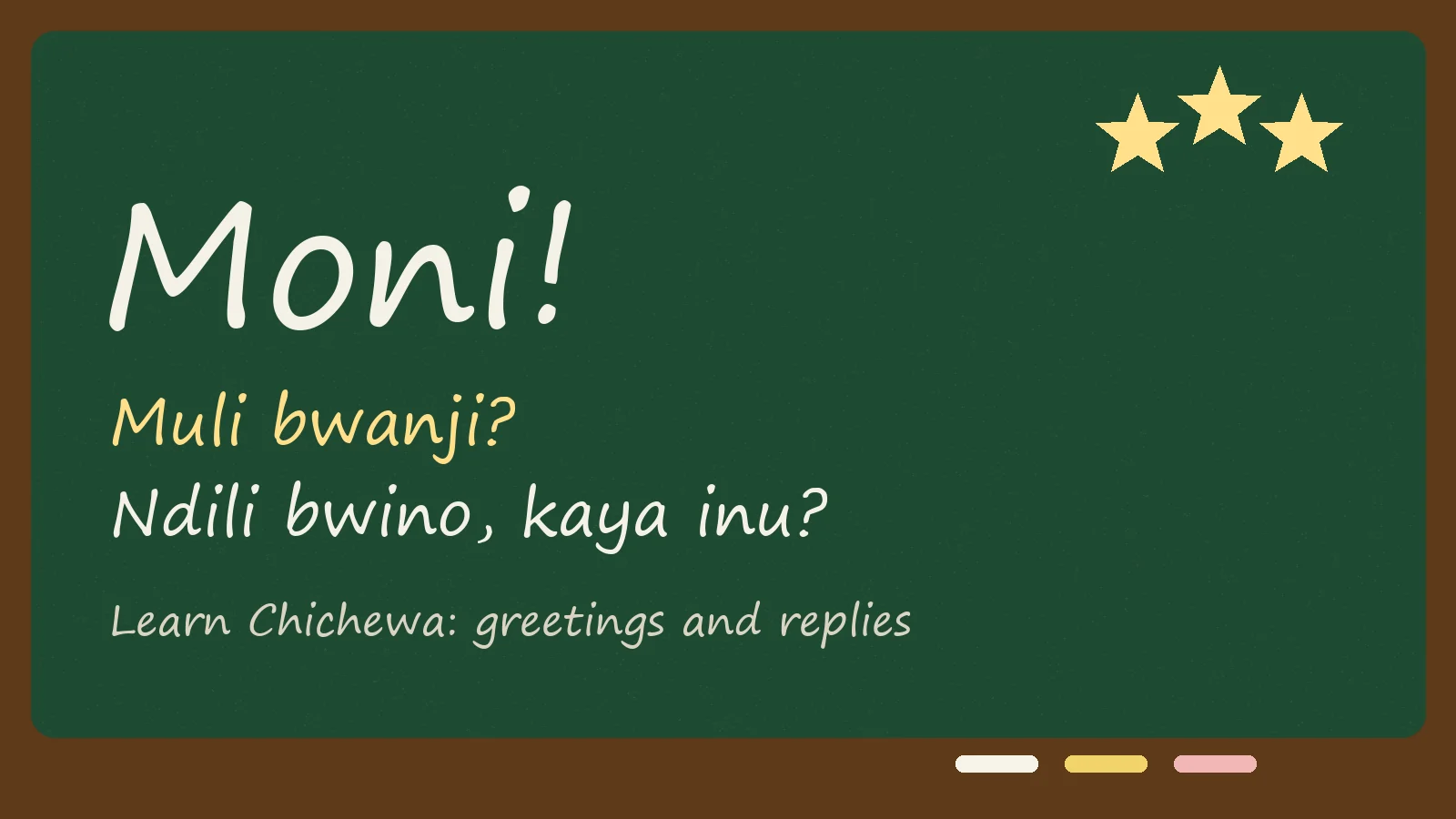
Moni!
Greet anyone in Malawi, the polite way.
CardsQuizMatch
Everyday Chichewa greetings and the right reply to each: five rounds of 10 questions, then a chat with a Malawian friend. Free to play, no account needed.
Five rounds and a chat
Tap to play
Pick New to Chichewa to start with word cards, or I know some to jump straight into the questions.
Play the rounds
Each round has 10 questions: pick the meaning, say it back, fill the gap and put the words in order. Get 5 right to open the next round, 8 for two stars and all 10 for three.
Finish with a chat
The last round is a chat with Chikondi: greet, give your name and say goodbye. Then race the clock in Match, and move on to the next lesson.
Greeting people properly matters in Malawi. People greet everyone they pass, ask how you are before any business, and close almost every exchange with zikomo. Learn these and you can start a polite conversation anywhere.
Playing is free and needs no account. To keep your stars and pick up where you left off, sign up free.
- Rounds
- 5, with 10 questions each
- Ways to play
- Lesson, Cards, Match
- Cost
- Free
- Account
- Only to keep your stars
All the greetings and replies in this lesson
Print it or keep it open while you play.
Hello and how are you
| Chichewa | English | How you say it |
|---|---|---|
| Moni | Hello | MOH-nee |
| Muli bwanji? | How are you?The polite way. Use it with anyone you do not know well. | moo-lee BWAN-jee |
| Ndili bwino | I am fine | ndee-lee BWEE-noh |
| Kaya inu? | And you? | KAH-yah EE-noo |
| Zikomo | Thank youAlso used for excuse me, and to close almost every greeting. | zee-KOH-moh |
Morning and afternoon
| Chichewa | English | How you say it |
|---|---|---|
| Mwadzuka bwanji? | Good morningMeans: how did you wake up? Use it before noon. | mwah-DZOO-kah BWAN-jee |
| Ndadzuka bwino | I woke up wellThe reply to good morning. | ndah-DZOO-kah BWEE-noh |
| Mwaswera bwanji? | Good afternoonMeans: how has your day been? Use it after noon. | mwah-SWEH-rah BWAN-jee |
| Ndaswera bwino | My day has been goodThe reply to good afternoon. | ndah-SWEH-rah BWEE-noh |
Names and manners
| Chichewa | English | How you say it |
|---|---|---|
| Abambo | SirAdd it to a greeting to show respect to a man. | ah-BAHM-boh |
| Amayi | MadamAdd it to a greeting to show respect to a woman. | ah-MAH-yee |
| Dzina lanu ndani? | What is your name? | DZEE-nah LAH-noo NDAH-nee |
| Dzina langa ndi … | My name is … | DZEE-nah LAHN-gah ndee |
| Inde | Yes | EEN-deh |
| Iyayi | No | ee-YAH-yee |
| Chonde | PleaseMany people say zikomo instead. | CHOHN-deh |
| Pepani | Sorry | peh-PAH-nee |
| Takulandirani | WelcomeMeans: we have received you. | tah-koo-lahn-dee-RAH-nee |
| Ndithu | Indeed, that is true | NDEE-too |
| Pang’ono | A littleSaid twice it means little by little, a common word of comfort. | pahng-OH-noh (the ng’ sounds like singer) |
Saying goodbye
| Chichewa | English | How you say it |
|---|---|---|
| Tionana | See you laterMeans: we will see each other. Also written tiwonana. | tee-oh-NAH-nah |
| Ndapita | Goodbye, I am offMeans: I have gone. | ndah-PEE-tah |
| Tsalani bwino | Stay wellSaid by the person who is leaving. | tsah-LAH-nee BWEE-noh |
| Yendani bwino | Go well, safe journeySaid to the person who is leaving. | yehn-DAH-nee BWEE-noh |
| Usiku wabwino | Good night | oo-SEE-koo wah-BWEE-noh |
| Gonani bwino | Sleep well | goh-NAH-nee BWEE-noh |
How Chichewa greetings work
Most greetings are a question with a set reply. Mwadzuka bwanji? asks how you woke up, so you answer Ndadzuka bwino, I woke up well. Mwaswera bwanji? asks how your day has been, and you answer Ndaswera bwino.
Use the polite forms on this page with anyone older than you or anyone you do not know. Add abambo for a man or amayi for a woman to show more respect. When you leave, you say tsalani bwino (stay well), and the people staying say yendani bwino (go well).
- Morning
- Mwadzuka bwanji?
- Afternoon
- Mwaswera bwanji?
- Any time
- Muli bwanji?
- Thank you
- Zikomo
Learning Chichewa greetings
How do you say good morning in Chichewa?
Mwadzuka bwanji? It means how did you wake up. The reply is Ndadzuka bwino, kaya inu? which means I woke up well, and you?
How do you say how are you in Chichewa?
Muli bwanji? The reply is Ndili bwino, kaya inu? (I am fine, and you?) and the other person answers Ndili bwino, zikomo.
How do you say thank you in Chichewa?
Zikomo. You will hear it all day: it also means excuse me, and it ends most greetings.
How do you say goodbye in Chichewa?
If you are leaving, say Tsalani bwino (stay well). If someone else is leaving, say Yendani bwino (go well). Tionana means see you later.
Do I need an account to play?
No. Anyone can play every game. A free account only keeps your stars and the words you have learned. Sign up here.
Is there sound?
Not yet. Each card shows how you say the word in plain English letters. We plan to add recordings by Malawian speakers.